By M S Nazki
This is out of the narrative as I read Bahadur comic books in my childhood! He had formed a fictitious Citizens security force!
Citizen’s Security Force (CSF):
Upon growing up, Bahadur set up the Citizen’s Security Force or the Hindi translation Nagrik Suraksha Dal (NASUD) that aids the police in combating dacoits. Though Bahadur dealt with many kinds of villains, he displayed a much softer corner towards dacoits trying to rehabilitate them. One of his assistants Lakhan was also a reformed dacoit. After surrendering to the police, he started helping Bahadur in curbing crime.
Now to the story proper:
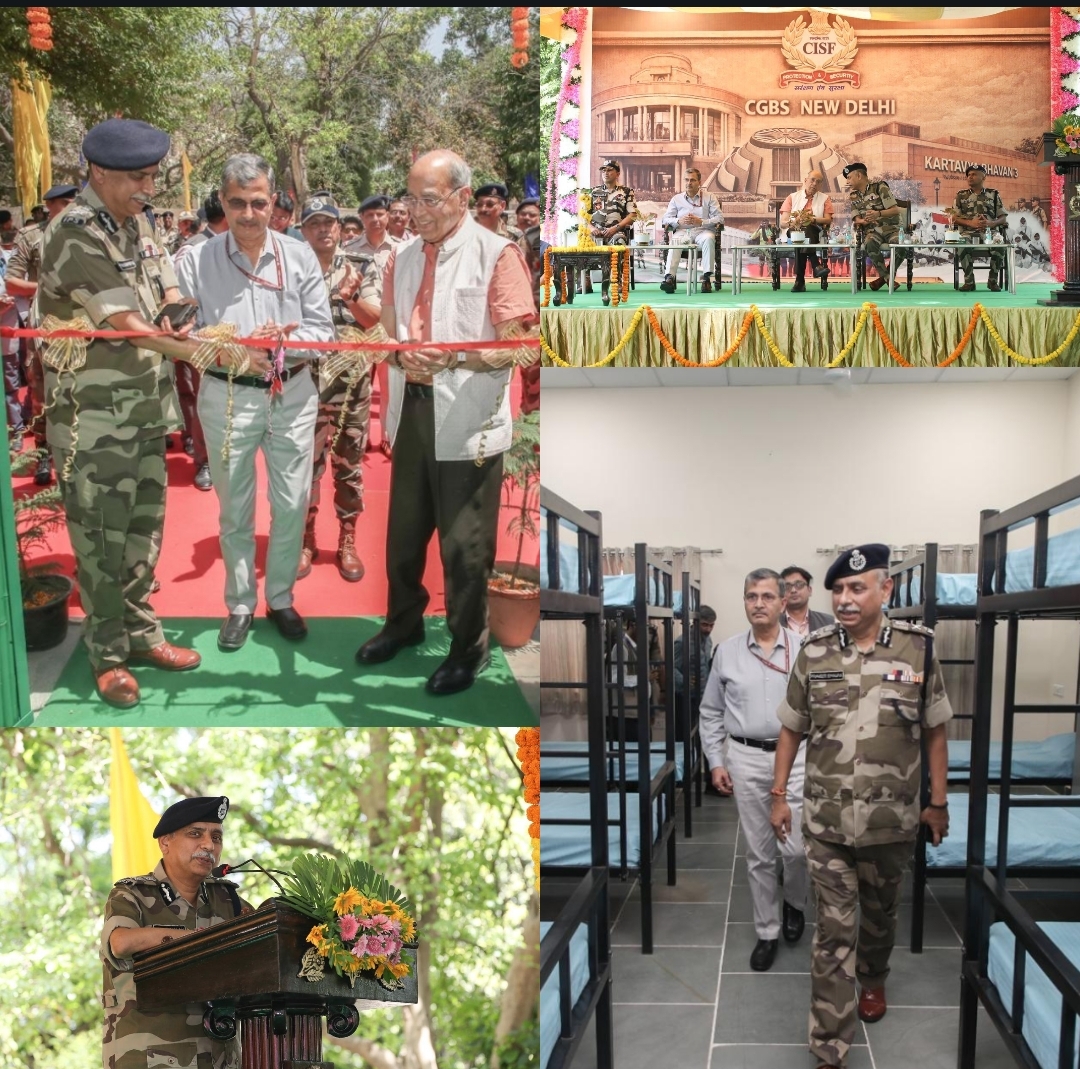
-DG CISF Inaugurates Newly Constructed Barrack Complex For CISF Personnel
-In a significant step towards strengthening welfare and living standards of CISF personnel, a newly constructed Barrack Complex at CISF Unit CGBS New Delhi, Prime Ministers’ Museum & Library (PMM&L), was inaugurated by Shri Praveer Ranjan, DG/CISF on 15.04.2026.
-The ceremony was graced by the presence of Shri Nripendra Misra, Chairman, PMM&L, Shri Ashwani Lohani, Director, PMM&L, Shri Saroj Kant Mallick, IG/NCR, and Shri G Sivakumar, DIG/CGBS, along with other dignitaries & senior officials.
-The barrack complex includes air conditioned living accommodation for 55 personnel, a spacious mess with seating capacity of 36 personnel at a time, with attached kitchen & ration store, and an integrated secure kote (armoury) for arms and ammunition—further enhancing comfort, morale and operational readiness at this nationally significant location.
-The Central Industrial Security Force (CISF) was raised on March 10, 1969, to provide specialized, dedicated security to India’s critical public sector undertakings (PSUs) and industrial undertakings. It was created to protect key national installations from 4theft, sabotage, and fire, largely in response to severe industrial disasters and security gaps.
-Key reasons and context for its formation include:
-Need for Specialized Security: A massive fire at the Heavy Engineering Corporation in Ranchi highlighted the need for a force better equipped than standard private security or police to handle industrial emergencies.
-Protecting Economic Assets: The goal was to secure vital national infrastructure, including power plants, steel plants, and industrial complexes.
-Expansion of Roles: While initially focused on central government industries, its role has expanded over the years to include guarding critical infrastructure such as airports, metro networks, space facilities, and key government buildings.
-Professionalization: The force was raised to ensure 24/7 security, professional management, and better protection of vital installations across the country.
-Central Industrial Security Force
-The Central Industrial Security Force (CISF) is one of the Central Armed Police Forces of India, under the Ministry of Home Affairs. The CISF’s primary mission is to provide security policing services to large institutions, whether state-owned or privately owned.
-The CISF was established under an Act of the Parliament of India on 15 March 1969 with a strength of 2,800. CISF was subsequently formally authorized by another Act of Parliament passed on 15 June 1983. Its current active strength is 148,371 personnel.
- In April 2017, the government raised the sanctioned strength from 145,000 to 180,000 personnel. Recently the strength has been increased to 200,000.
-Among its duties are providing law enforcement and security services to sensitive governmental buildings, the national Parliament complex, the Delhi Metro, and providing airport security and policing services.
-CISF also provides consultancy services to private industries as well as other organisations within the Indian government. The scope of CISF’s consulting practice includes security consulting and fire protection consulting.
-It also plays a major role in Disaster Management. The CISF has a ‘Fire Wing’ which helps during fire accidents in Industries where the CISF is on guard.
-History
-The Central Industrial Security Force (CISF) was established by an Act of Parliament on 10 March 1969 with an initial sanctioned strength of approximately 188,000 personnel.
-As its name indicates, it was created to provide better protection and security to industrial undertakings across the country. Initially, protection was limited to industries wholly owned by the Central Government. This restriction has since been relaxed, and the CISF now also safeguards joint-venture enterprises in which the Central Government has a stake.
-Over the years, the role of the CISF has significantly expanded and diversified. Today, in addition to industrial units, it provides security to airports, seaports, metro rail networks, key government buildings, heritage monuments (including the Taj Mahal and Red Fort), opium and alkaloid extraction units, nuclear power plants, and space establishments.
-The CISF also specialises in VIP security and disaster management. Currently, it performs a wide range of duties related to internal security, election security, anti-Naxal operations, and any other tasks assigned to it by the Government of India.
- Structure and organisation
-The CISF is headed by an Indian Police Service officer with the rank of Director-General, assisted by an IPS officer in the rank of Addl. Director-General. The force is divided into Nine Sectors (Airport, North, North-East, East, West, South, Training, South-East, Central) and also has a Fire Service Wing.
-The Airport Sector is commanded by an IPS officer in the rank of Addl. Director-General, assisted by an Inspector-General. The Airport Sector is divided into a number of Field Formation Units, one for each airport. Units at major international airports are commanded by a Deputy Inspector-General or Commandant; units at smaller airports by a Deputy or Assistant Commandant. The other six Sectors are each commanded by an Inspector-General, who is assisted by a Deputy Inspector-General.
-The seven regional Sectors are divided into Zones, each commanded by a Deputy Inspector-General. Within each Zone are a number of Units, each under the command of a Commandant, or a DIG for certain major Units.
- A Deputy Commandant serves as the second-in-command of most units, or as the head of a smaller unit. Within the Training Sector, the National Industrial Security Academy (NISA) is headed by an Inspector-General; the Fire Service Training Institute (FSTI) and six other recruit training centres are headed by Deputy Inspectors General.
-The Financial Adviser of the CISF has been an Indian Revenue Service officer of the rank of Director and also has Dy Advisers from the Indian Audit and Accounts Service and Indian Civil Account Service.
-Being a central Indian police agency and having a high presence of Indian Police Service officers, CISF follows ranks and insignia similar to other police organisations in India. Non-gazetted (enrolled) officers and members use the same ranks as other Indian police forces.
-In the context of the Central Industrial Security Force (CISF), NCR refers to the National Capital Region (Delhi/NCR) Sector, a critical administrative and operational zone responsible for securing high-profile infrastructure. This zone includes key installations like the Indira Gandhi International (IGI) Airport, DMRC (Delhi Metro), and major government buildings.
-Key details regarding CISF in the NCR:
-Key Responsibilities: The CISF NCR sector provides security for the Delhi Metro, Indira Gandhi International Airport, Parliament House, and other critical government buildings.
-Expansion & New Responsibilities: CISF has taken over security for the Regional Rapid Transit System (RRTS) “Namo Bharat” corridor in the NCR.
-Women’s Reserve Battalion: A new specialized women’s battalion is being established in Nuh, Haryana, to specifically serve NCR units.
-Leadership & Command: The sector is managed by senior officers, such as the IG/NCR (Inspector General) and DIG/NCR (Deputy Inspector General).
-Personnel Care: The sector includes infrastructure for personnel, such as the MT Park at DMRC, which features a gym and recreational facilities.
The “Bravehearts” of the Central Industrial Security Force (CISF) are personnel who made the ultimate sacrifice in the line of duty, protecting India’s vital infrastructure, including airports, metros, and nuclear installations. These heroes, often honored on the Bharat Ke Veer portal, include personnel killed in Naxal-affected areas, terror attacks, or while maintaining law and order.
-Honored Martyrs: Recently honored include CT/GD Roken Singh, CT/GD Kulwant Raj, and CT/GD B. C. Baruah.
-Posthumous Awardees (2025): Recognized for supreme sacrifice in Naxal-affected and security roles: SI(GD) Mahendra Singh, Ct(GD) Narender Kumar, and Ct(GD) Ranjit Yadav.
-Key Recognition: The CISF commemorates these individuals, with former Incharge DG Smt Nina Singh having felicitated families at the National Police Memorial.
-Operational Sacrifices: Many laid down their lives fighting Naxalites, such as in the 2012 BIOM Kirandul incident.
-A new barrack complex was inaugurated for CISF personnel (specifically at the Prime Ministers’ Museum & Library in Delhi) to enhance operational readiness, security, and personnel welfare.
-The new facilities, inaugurated in April 2026, were designed to provide better living standards for personnel assigned to key national institutions.
-Key Reasons for the New CISF Barrack:
-Improved Living Conditions: The complex features modern air-conditioned accommodation for 55 personnel, replacing older or less efficient setups.
-Better Infrastructure: It includes a well-equipped mess with a dining capacity of 36 personnel, along with a kitchen and ration store.
-Increased Security & Preparedness: It houses an integrated armoury (secure kote) to ensure enhanced operational efficiency and quick response times.
-Welfare and Morale: By improving accommodation at critical sites, the initiative aims to boost the motivation of personnel tasked with protecting high-value locations.
-Response to Deployment Needs: As CISF takes on responsibility for more national locations (like the PMML in 2022), the demand for high-quality, on-site housing for personnel increases.
-This development is part of a broader push to improve infrastructure for Central Armed Police Forces (CAPF) to enhance efficiency and welfare.
The final lines: Always vigilant and alert to squash any threat. CISF – Sentinels of India’s Critical Infrastructure! Known for their determination, discipline and dedication, #CISF plays a vital role in safeguarding critical infrastructure across the nation. They are the Sentinels of prosperity! Protectors of progress! Keepers of legacy!

 Sheikh Sameer