M S Nazki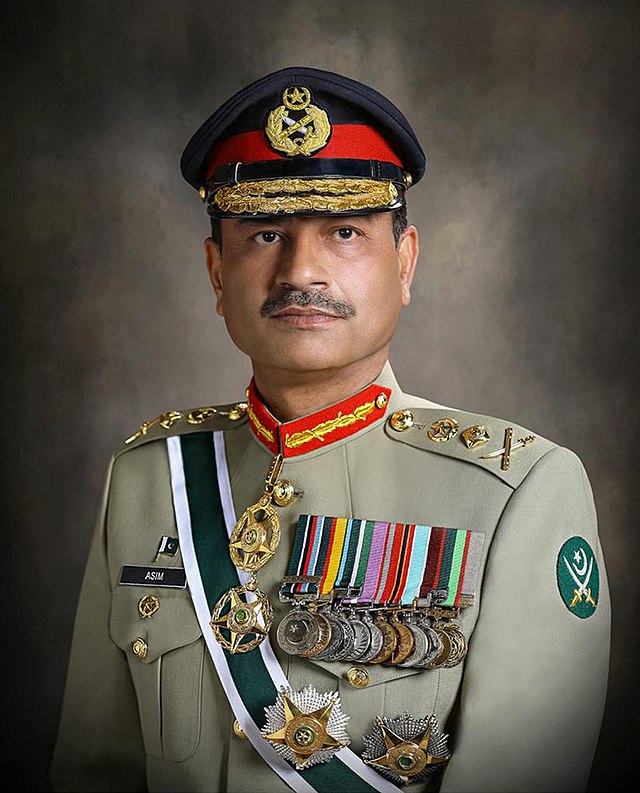
By M S Nazki
Field Marshal (the second in Pakistan after Ayub Khan) Asim Munir believes in untruth, covertness, unscrupulousness and falsehood and that is very visible as how he conducted himself after Pahalgam carnage in which innocents were targeted!……………Part-II
-He is a man who can be treacherous and cagey and this is yet another implication that India should be vary off!
Escalation of tensions:
The promotion could be seen as a symbolic gesture of defiance and a sign of Pakistan’s readiness to challenge India’s dominance in the region.
-Increased strategic awareness: India will need to closely monitor Pakistan’s military activities and be prepared for potential escalations.
-Potential shift in power dynamics: The promotion could signal a change in Pakistan’s military leadership and influence, potentially impacting regional security.
-Diplomacy and dialogue: The promotion could complicate ongoing diplomatic efforts between the two nations, making it more challenging to address differences and reach peaceful resolutions.
-It is a super-elite military club, unlike any in South Asia. Till May 20, 2025, this exclusive club of field marshals had only three former army chiefs as its members. Sam Manekshaw and KM Cariappa from India and Ayub Khan from Pakistan.
-The government of Pakistan promoted Chief of the Army Staff Gen Asim Munir to the rank of field marshal in recognition of his ‘strategic leadership and decisive role’ in defeating India in the conflict that started earlier this month following the Pahalgam incident in Kashmir (falsehood ofcourse).
-In a sign that the civilian leadership in Pakistan may be on the backfoot again, Prime Minister Shehbaz Sharif posted on X, saying: “Under his command, our valiant armed forces staunchly defended Pakistan’s sovereignty and territorial integrity with unity, courage and the highest standards of military professionalism.”
-Vijay Nambiar, a former Indian high commissioner to Pakistan, believes this “appointment is an attempt to build its own structure of untruth”. While agreeing that it could potentially represent a harder line against India, Nambiar told such an appointment lacked any real credibility.
-Munir’s elevation has sparked speculation among experts about a growing shift towards military rule in Pakistan. Analysts suggest that in the aftermath of the Indian Army’s Operation Sindoor, the Pakistani military seems to be increasingly asserting control over the civilian government led by Shehbaz Sharif.
-Says Ayesha Siddiqa, Pakistan’s best-known expert on all military affairs: “It was, in a way, coming. Pakistan had not lost the war with India and there was a feel-good factor in the country. Now with this one move, Munir has brought negative attention to himself. Frankly, it was not needed.”
-Munir’s promotion has set off widespread speculation about its implications for Pakistan’s higher defence organisation (HDO), comprising the joint chiefs of staff committee (JCSC), headed by its chairman, and the three service chiefs (army, navy, air force).
-While the five-star title is largely ceremonial, questions have also been raised about its impact on the civil-military balance, the operational command chain, and the defence leadership’s future.
-Pakistan has a significant history of military rule, with the army directly governing the country for roughly half of its existence since 1947. This includes periods like 1958-1971, 1977-1988, and 1999-2008. Even during periods of civilian government, the military has exerted considerable influence, often wielding power behind the scenes, including meddling in elections whenever they were held.
-The rank of field marshal symbolises exceptional ‘wartime leadership’. In the case of the new Pakistani field marshal, experts question how that phrase applies to him when Indians hit Pakistan and Pakistan-occupied Kashmir (PoK) with missiles on May 7. India said it struck nine “terrorist infrastructure” sites, some of them linked to an attack by Islamist militants.
-The position of field marshal does not carry any additional command authority or salary benefits. However, it allows the holder to remain on the active list even after retirement, enabling them to wear the uniform and display special insignia for life. The rank includes privileges such as five stars on the official vehicle and the use of a special baton during salutes.
The man’s background goes something like this: Syed Asim Munir Ahmed Shah[a] (born 1968) is a five star Pakistani military officer who is currently serving as the 11th Chief of the Army Staff of the Pakistan Army since 2022. Prior to becoming the army chief, he was posted at the GHQ as Quartermaster general. He commanded the XXX Corps in Gujranwala from 17 June 2019 to 6 October 2021. He served as the 28th Director-General of the ISI until he was replaced by lieutenant general Faiz Hameed on 16 June 2019.
Munir received the Sword of Honour for his performance as a cadet in the Officers Training School (OTS), Mangla.
Munir was born in Rawalpindi, Pakistan in 1968into a Punjabi family, with their roots lying in Jalandhar, Punjab, India, from where his parents migrated following the 1947 partition of India. They moved to Toba Tek Singh before settling down in Rawalpindi’s Dheri Hassanabad. His father, Syed Sarwar Munir, was the principal of the FG Technical High School, Lalkurti, Rawalpindi and the imam of a mosque, Masjid-al-Quraish, situated in a locality of Dheri Hassanabad, where he often delivered the Friday Khutbah sermon.
Munir got his early religious education in a traditional Islamic seminary in Rawalpindi, the Markazi Madrasah Dar-ul-Tajweed, in his youth also being a local cricketer as a fast bowler.
Later, Munir graduated from the Fuji school, Japan, the Command and Staff College, Quetta, the Malaysian Armed Forces College, Kuala Lumpur and the National Defence University, Islamabad, where he earned his MPhil in Public Policy and Strategic Security Management.
As a lieutenant colonel, Munir served in Riyadh, Saudi Arabia as part of the close defence cooperation between Riyadh and Islamabad, and also served in the Siachen Glacier.
While he was a brigadier, he served as the chief of staff of Pakistan’s I Strike Corps Mangla, and commanded an infantry brigade in the Northern Areas. He was promoted to the rank of Major general in 2014 and served as the commander of the troops deployed in the Northern Areas of Pakistan.
Munir also served as the director-general of Military Intelligence in 2016. He was awarded the Hilal-i-Imtiaz in March 2018. Munir was promoted to the rank of lieutenant general in September 2018 and was subsequently appointed as DG ISI. In June 2019, Munir was replaced by Lt. Gen. Faiz Hameed as the new DG ISI. Subsequently, Munir was appointed as corps commander of XXX Corps in Gujranwala in 2019.
From 2021 to November 2022, Lt-General Munir was posted at GHQ as the Quartermaster General of Pakistan Army. In November 2022, Lieutenant General Munir was promoted to the four-star general rank and appointed as the Chief of the Army Staff of the Pakistan Army.
At the time of his appointment as COAS, Munir was the most senior lieutenant general of the Pakistani army. In December 2022, General Munir received the Nishan-i-Imtiaz (Military) award from President Arif Alvi. At the Aiwan-e-Sadr, top military officials were given special investitures in front of Prime Minister Shehbaz Sharif, diplomats, lawmakers, and federal ministers were present during the ceremony.
Munir is the second recipient of the Sword of Honour who has risen to the position of army chief in the military history of Pakistan, after Asif Nawaz Janjua. Additionally, he is the only army chief in the history of Pakistan who has earlier served as chief of both premier military intelligence agencies of Pakistan, namely, Inter-Services Intelligence and Military Intelligence.
Munir was appointed the DG-ISI on 25 October 2018, under the tenure of Imran Khan. He oversaw the 2019 skirmish with India, relaying critical information between the two countries, and holding an important role. Pakistan’s retaliation against India was triggered by the Munir-led committee who strongly advised Pakistan’s civil-military leadership to respond to the Indian threat. Munir’s tenure as DG-ISI is the shortest in the country’s history. It is alleged Munir was removed by Qamar Javed Bajwa under pressure from Imran Khan when Munir claimed to have exposed the corruption of Khan’s wife, Bushra Bibi.
In May 2023, Imran Khan was arrested, when he was released on bail, Munir found himself under direct criticism from Khan, with Khan accusing him of “dismantling the future of this country [Pakistan] to protect himself.” Following the arrest of Khan, reports emerged indicating a division within the Pakistan Army. Khan’s arrest resulted in the May 9 riots, where military installations were attacked, looted, and ransacked.[ Munir visited the places where rioting had occurred, and vowed that such an event would never reoccur. Munir’s reaction lead to the attempt of trying civilians under military courts, which received criticism from international observers as military courts are not seen as impartial and fair.
Munir has been adamant on solving the economic crisis in Pakistan by setting up the Special Investment Facilitation Council, intending to bring in billions of dollars of investment from abroad, especially Pakistan’s Gulf allies. The economic crisis, led to the Pakistani rupee devaluing to its weakest in its history, valuing at 308 per dollar. As a measure to strengthen the rupee, he initiated crackdowns on the black market, which had been selling dollars illegally, which was harming the rupee. These crackdowns were successful, and the Pakistani rupee had rebounded to become the world’s best-performing currency in September 2023.
Munir is a Muslim, and he is deemed as a conservative figure regarding religion. Munir’s family are locally known as a hafiz family, as its many members are known to have memorized the entire Qu’ran by heart, including Munir, who did so during his posting in Saudi Arabia as a Lieutenant-Colonel. He is the first army chief in Pakistan’s history to have memorized the entire Qur’an.
This is what Asim Munir is! (concluded)!
Author


 Sheikh Sameer


 The Kashmir Dialogues