Sheikh Sameer
For decades, the story of education in Kashmir was overshadowed by uncertainty, political unrest, disrupted classrooms, and an academic atmosphere trapped between conflict and instability. Schools remained shut for months, colleges frequently turned into centres of protests, examinations were repeatedly postponed, and students often found themselves disconnected from the competitive academic rhythm of the rest of the country.
The Valley’s education system, once admired for producing scholars, intellectuals, bureaucrats, doctors, engineers, and academicians, gradually became one of the greatest victims of prolonged turmoil. Academic calendars were replaced by shutdown calendars, educational institutions became vulnerable to political influence, and merit often struggled to survive within an atmosphere dominated by fear, pressure, and uncertainty.
However, since 2020, Jammu and Kashmir has witnessed what many describe as an educational renaissance. Under the leadership of the Lieutenant Governor administration, particularly under the stewardship of Manoj Sinha, the educational structure of Kashmir has undergone a massive transformation. The implementation of the National Education Policy (NEP) 2020, restoration of regular academic schedules, modernization of institutions, timely examinations, digitization, institutional discipline, and merit-based governance have collectively reshaped the Valley’s academic landscape.
Today, Kashmir’s educational institutions are increasingly becoming centres of competition, innovation, research, entrepreneurship, and academic excellence rather than spaces associated with unrest and uncertainty.
The Kashmir Classroom Before 2020: Education in the Shadow of Conflict
For years, Kashmir’s educational system operated under extraordinary challenges. Students frequently lost months of education due to shutdowns, protests, curfews, and disturbances. Schools and colleges often remained closed not because of weather or administrative reasons, but because of political uncertainty and separatist calendars that dictated public life in the Valley.

Educational institutions, especially colleges and universities, increasingly became vulnerable to radical narratives and protest culture. Street protests often originated from campuses, and academic environments became deeply politicized. Instead of focusing solely on careers, innovation, or research, many students grew up amid constant disruption and instability.
The consequences were devastating.
Examinations were delayed repeatedly, results arrived months late, admissions suffered, and students found themselves academically disconnected from national educational timelines. Thousands of students preparing for competitive examinations struggled because their academic sessions rarely synchronized with institutions outside Jammu and Kashmir.
Teachers too operated under immense pressure. Honest, dedicated, and academically committed teachers often found themselves marginalized, harassed, or threatened simply for maintaining discipline or refusing political interference. In many cases, even a minor political worker or influential local intermediary could influence transfers and postings.
There existed a widespread perception that if a teacher refused to cooperate with vested interests or remained committed strictly to educational discipline, he or she could be transferred to remote or difficult locations as a form of punishment. Unfortunately, many such fears later proved true. Merit and capability often became secondary to influence and pressure.
This culture deeply damaged the morale of the teaching community.
Instead of rewarding professionalism, the system frequently subjected sincere educators to uncertainty and administrative harassment. Teachers who wanted classrooms to function normally were sometimes portrayed negatively simply because they prioritized academics over disruption.
The Turning Point: Educational Transformation After 2020
The year 2020 marked a major turning point in the history of Kashmir’s education sector. The introduction of the National Education Policy (NEP) 2020 by the Government of India opened a new chapter focused on modernization, skill development, flexibility, innovation, and multidisciplinary learning.
Under Lieutenant Governor Manoj Sinha’s administration, the implementation of NEP in Jammu and Kashmir received strong institutional backing. The administration projected education as the foundation for peace, empowerment, and long-term transformation.
The focus shifted dramatically:
From shutdowns to structured academic calendars
From uncertainty to stability
From protests to performance
From political influence to merit-based administration
From campus disruption to competitive excellence
The change was not merely administrative; it represented a psychological transformation in the educational culture of Kashmir.
The End of the “Shutdown Calendar Culture”
One of the most remarkable changes after 2020 has been the restoration of the academic calendar system across educational institutions.
For years, separatist-issued calendars and shutdown calls repeatedly disrupted educational activities. Students prepared for examinations without knowing whether exams would actually be conducted on schedule. Parents feared uncertainty, and institutions struggled to complete syllabi.
Today, the situation has changed drastically.
Schools, colleges, and universities increasingly function according to official academic schedules. Examinations are conducted on time, classes run regularly, and results are declared within fixed timeframes. Students now experience academic continuity that earlier generations could only hope for.
This restoration of educational discipline has significantly improved student confidence. Academic life is no longer held hostage to uncertainty.

Merit Replaces Pressure Politics in Teacher Postings
Perhaps one of the most quietly transformative changes has emerged in the functioning of the education department itself.
Earlier, teachers frequently complained that transfers and postings were influenced by political pressure, local interference, or lobbying networks. Dedicated teachers who focused sincerely on academics often faced harassment or threats of transfer to remote areas merely because they refused to bow before pressure groups.
That culture, according to many educators, has gradually weakened.
Today, teacher placements and postings are increasingly viewed through the lens of merit, institutional requirement, subject expertise, and capability rather than political recommendations. Teachers are being posted according to educational needs and administrative planning instead of local pressure mechanisms.
This shift has restored morale among large sections of the teaching fraternity.
Teachers now increasingly feel that professionalism, discipline, and performance matter more than political connections. Educational institutions benefit when capable teachers are placed where they are most needed instead of where influence dictates.
The administration’s emphasis on accountability and institutional discipline has also strengthened public confidence in the education system.
Students Competing, Not Protesting
Another defining feature of the post-2020 educational transformation is the emergence of a new competitive culture among Kashmiri students.
Today, students across the Valley are increasingly preparing for:
NEET
JEE
CUET
UPSC
JKPSC
Banking examinations
Engineering and professional entrance tests
National scholarship programs
Coaching centres, digital learning platforms, skill institutes, and career counseling programs have expanded rapidly.
Earlier, disrupted academic sessions and delayed examinations created severe disadvantages for students competing nationally. Now, synchronized academic schedules and timely results allow Kashmiri students to compete more effectively with students from across India.
This change reflects a broader psychological transformation: ambition is gradually replacing uncertainty.
Cleaning Campuses: Action Against Anti-National Elements
A major and often debated aspect of the educational reforms has been the crackdown against employees accused of promoting anti-national activities within educational institutions and government departments.
The administration adopted a zero-tolerance policy toward individuals allegedly involved in separatist propaganda, radicalization, or activities considered prejudicial to national security. Several teachers, professors, and government employees faced dismissal under Article 311 over alleged anti-national involvement.
Reports suggest that dozens of employees across sectors, including education, were removed from service following investigations into alleged anti-national links.
The administration argued that schools, colleges, and universities must function as centres of nation-building and intellectual growth—not spaces for radicalization or political indoctrination.
Supporters of these measures believe that removing such elements helped restore academic discipline and depoliticize campuses. Educational institutions are now increasingly associated with examinations, placements, innovation, and career development instead of confrontation and unrest.
Digital Revolution and Smart Education
The post-2020 era also accelerated digitization across Kashmir’s education system.
Smart classrooms, online attendance systems, virtual lectures, digital learning platforms, and e-content delivery mechanisms expanded significantly. The COVID-19 pandemic further accelerated technological integration in schools and colleges.
Universities and higher educational institutions adopted online admissions, digital evaluation systems, and virtual training modules. Teachers underwent training to adapt to modern pedagogical methods.
The digital shift helped reduce academic isolation and exposed students to broader national and global educational resources.
NEP 2020 and the Rise of Skill-Based Education
The implementation of NEP 2020 introduced a more modern and flexible educational framework focused on: Skill development
Vocational education
Innovation
Multidisciplinary learning
Entrepreneurship
Critical thinking
Practical knowledge
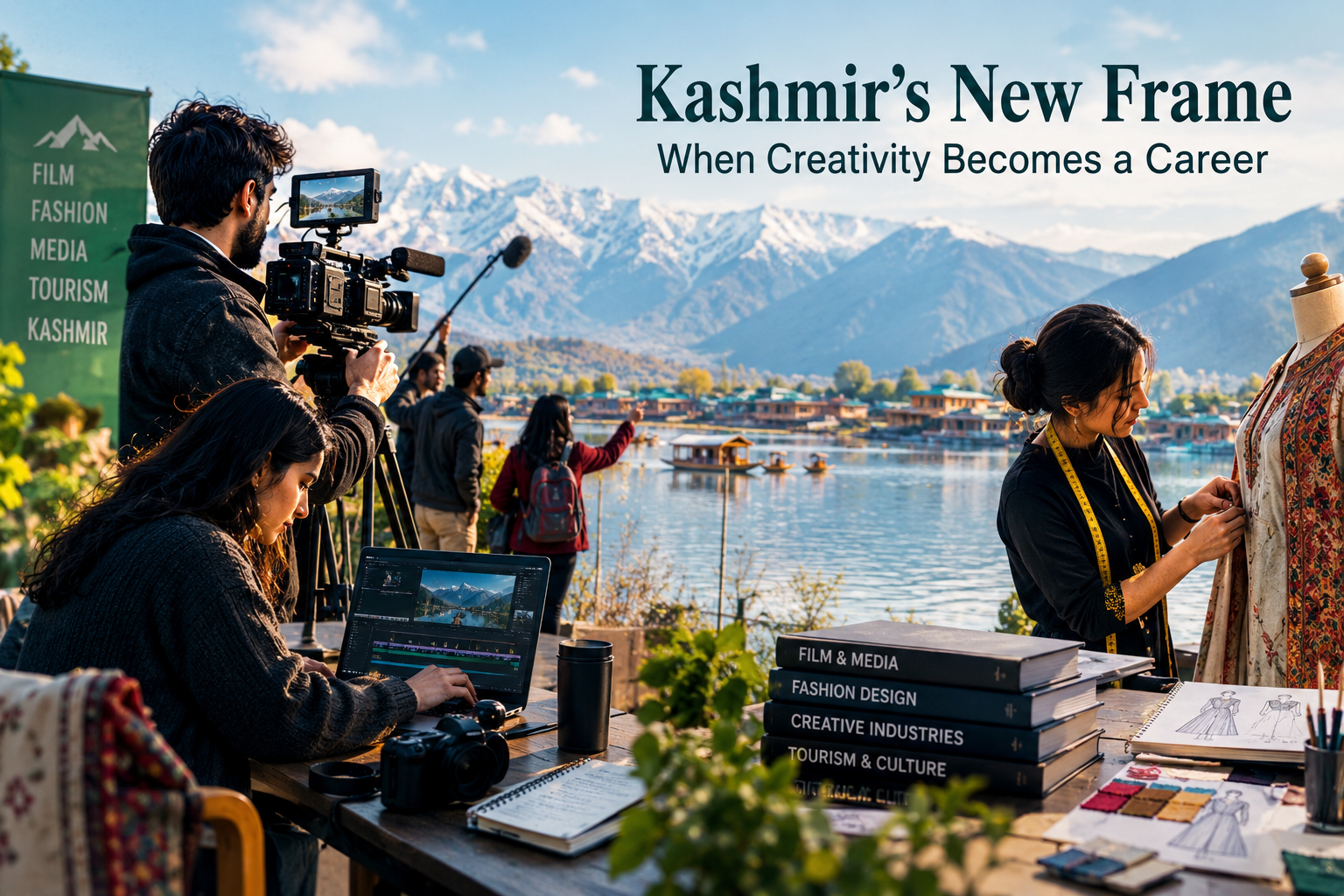
Professional and technical education institutions increasingly aligned themselves with market-oriented learning. Students are now encouraged not only to seek government jobs but also to explore startups, entrepreneurship, research, and skill-based careers.
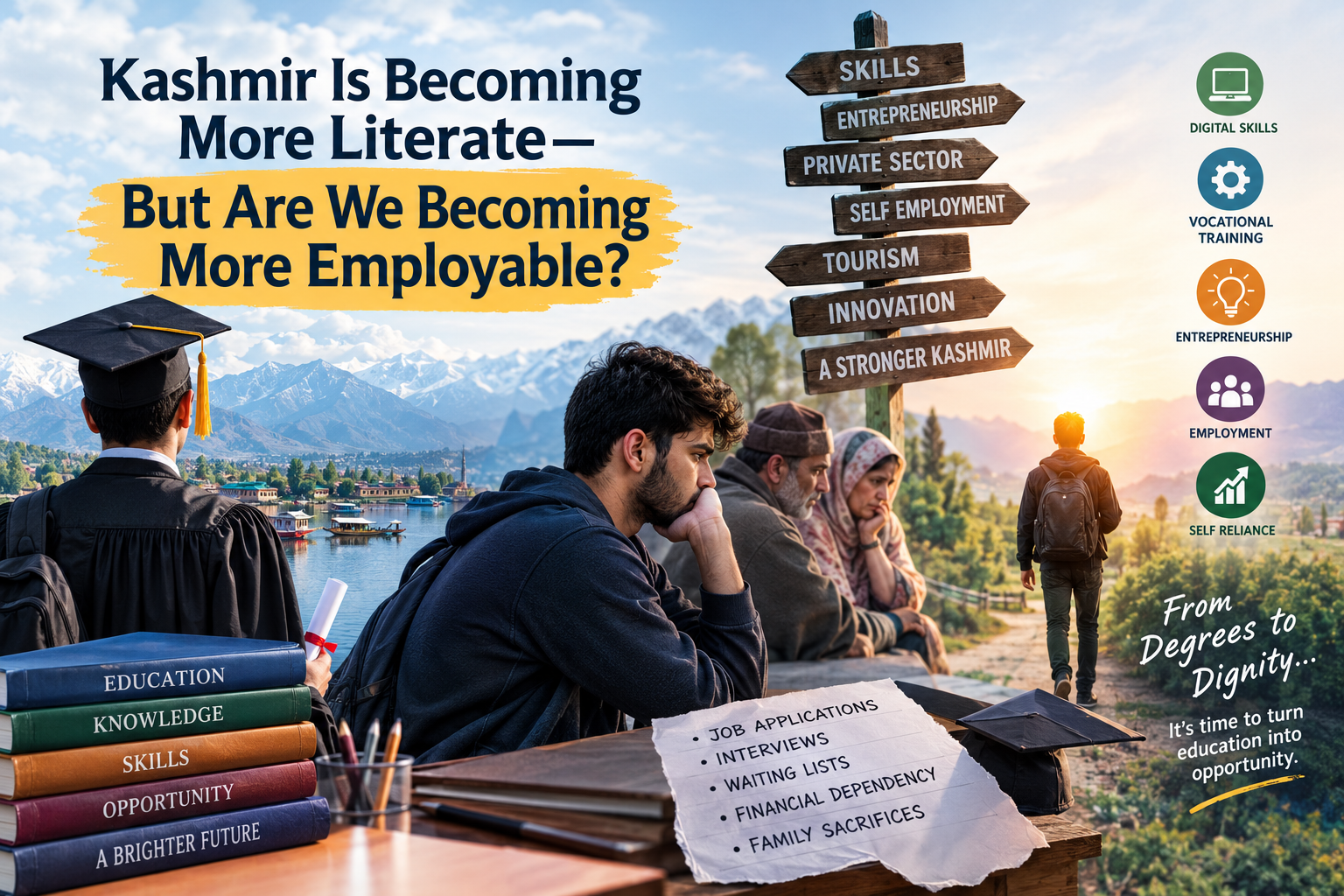
This transformation is especially important in Kashmir, where unemployment among educated youth had emerged as a major concern.
Manoj Sinha and the New Educational Narrative
Much of Kashmir’s educational transformation since 2020 has been strongly associated with the leadership of Lieutenant Governor Manoj Sinha. The LG administration consistently emphasized that the future of Jammu and Kashmir lies in empowering its youth through education, stability, and opportunity.
Under this approach, education was not viewed merely as an administrative sector but as a strategic instrument for social transformation, peace-building, and long-term development.
The administration focused simultaneously on:
Restoring institutional discipline
Ensuring regular examinations
Promoting meritocracy
Modernizing infrastructure
Implementing NEP 2020
Removing disruptive elements
Encouraging competitive excellence
The result has been a visible shift in the educational atmosphere across the Valley.
From Conflict to Competition
The story of Kashmir’s educational transformation since 2020 is ultimately a story of transition—from conflict-driven uncertainty toward aspiration-driven progress.
The Valley that once witnessed repeated disruptions in classrooms is now increasingly witnessing students preparing for national examinations, participating in innovation programs, and dreaming beyond the limitations of the past.
Teachers who once feared harassment for maintaining discipline now increasingly work within a more structured and merit-oriented environment. Institutions once associated with unrest are gradually becoming spaces of academic competition and intellectual growth.
Challenges still remain. Rural educational inequality, infrastructure gaps, teacher shortages, and the need for greater research investment continue to demand attention. Yet the direction of change is undeniable.
Kashmir’s educational narrative is being rewritten.
And perhaps for the first time in many decades, the sound echoing through the Valley’s classrooms is not the uncertainty of shutdowns—but the confidence of ambition, learning, and hope.