M S Nazki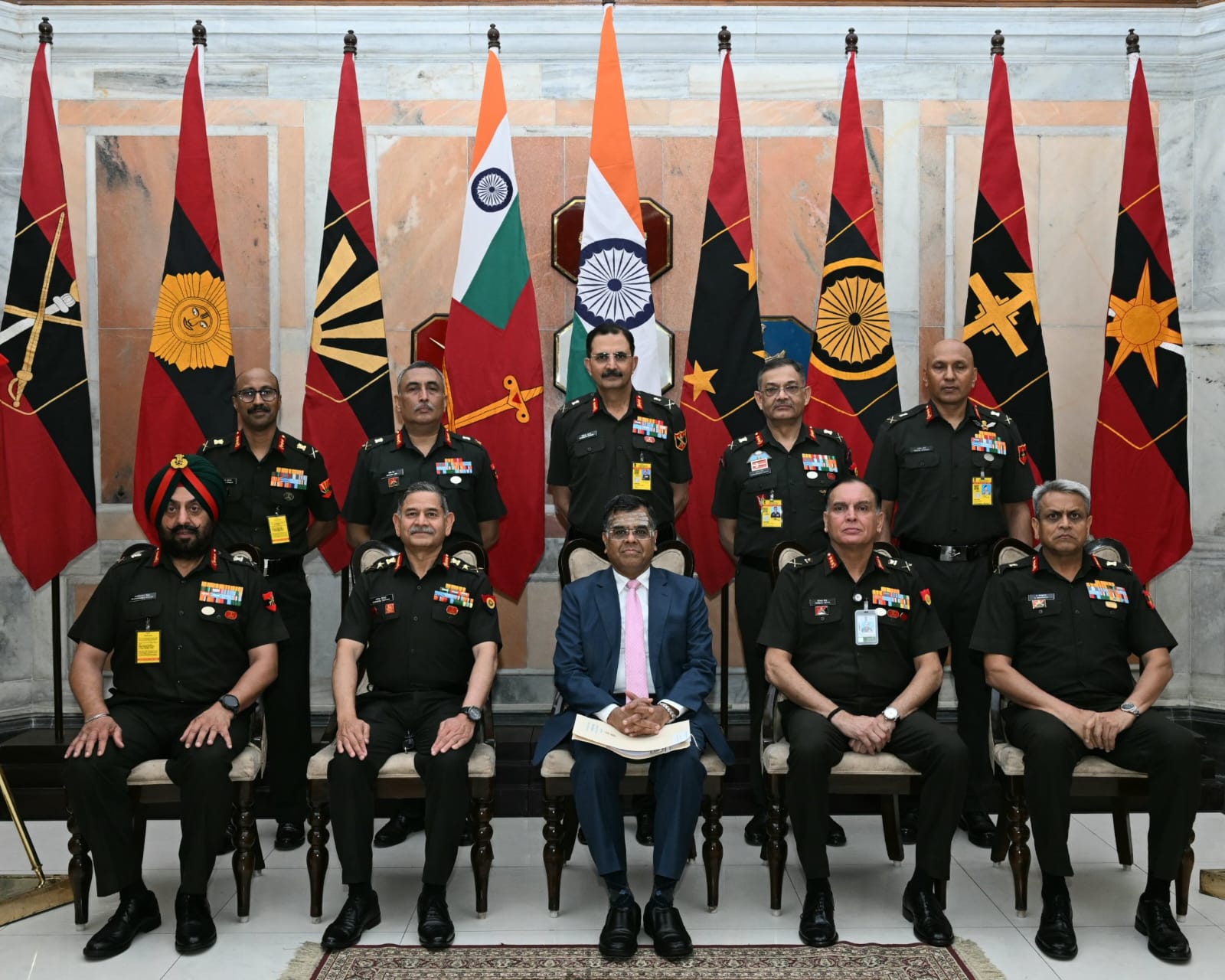
By M S Nazki
Even the greatest was once a beginner. Don’t be afraid to take that first step or beat it! There is always a second chance…………..!
-I will again start this one with a story!
-He was a lame duck, skinny to the core! But he took a lot of care about me! We used to share Tiffin boxes! He loved my food which my mother used to prepare and I loved his! One day I asked him why are you so shy, you can compete, you are so good at studies why not in sports? His reply was a shocking one, ‘I dislike sports!’ But I knew I could make him a sportsman! I Cajoled him, coaxed him and trained him! It all started with a morning walk with a dog! If I correctly remember the whisper was his name (Dog)! He began running……….If wheels can take you faster then why not legs! This was the transfer I wanted!………The man became a boxer and till date he is aggressive……….
-Now to the Story proper:
During the ongoing Army Commanders’ Conference in New Delhi, the Cabinet Secretary, Dr T V Somanathan, addressed the senior leadership of the Indian Army and highlighted key strategic imperatives for national preparedness in an increasingly complex global environment. In his address, he emphasised the critical need to develop sovereign Artificial Intelligence models and underscored the importance of resilient supply chains to safeguard national interests amid evolving geopolitical challenges. He also stressed the necessity of stronger civil-military cooperation and observed that a whole-of-nation approach remains essential for achieving optimal outcomes in both conflict and peacetime. Speaking on Atmanirbharta, the Cabinet Secretary described it not merely as a policy objective, but as a national mindset in which every sector, every institution and every citizen contributes towards building a self-reliant and resilient India. The interaction formed part of the ongoing Army Commanders’ Conference deliberations focused on strengthening national security, preparedness and institutional synergy
-The first Army Commanders’ Conference (ACC) of 2026 is being held in New Delhi from April 13 to April 16, 2026, focusing on strategic, operational, and technological readiness. Top military leaders are reviewing the security situation, with key discussions highlighting Atma Nirbharta (self-reliance), AI, theaterization, and the 2026-27 plan for “networking and data centricity”.
-Key Highlights of the Conference:
-Strategic Focus: Cabinet Secretary Dr. T.V. Somanathan emphasized developing sovereign AI capabilities and resilient supply chains.
-Maritime Security: Admiral Dinesh K. Tripathi (CNS) addressed the conference, highlighting the importance of securing sea lines of communication and enhancing tri-service synergy.
-Key Themes: Discussions centered on the evolving security landscape, military modernization, and “Atma Nirbharta”.
-Future Readiness: The conference aims to lay down priorities for a future-ready Army, focusing on advanced technologies such as unmanned systems and improved surveillance.
-Administrative Focus: The meeting included reviews of human resources, with a focus on personnel empowerment and the “Year of Networking and Data Centricity”.
-The conference acts as a major, high-level forum for finalizing key policy decisions for the Indian Army, concluding with a, as noted on, “Combined Commanders Conference”.
-About Dr. T.V. Somanathan:
Dr. T.V. Somanathan is a 1987-batch IAS officer of the Tamil Nadu cadre who took charge as the Cabinet Secretary of India on August 30, 2024. As the highest-ranking civil servant, he leads India’s bureaucracy, chairs the Civil Services Board, and reports to the Prime Minister. He is known for his work in public finance and economic policy.
-Key facts about Dr. T.V. Somanathan include:
-Role and Tenure: Succeeding Rajiv Gauba, he is the 33rd Cabinet Secretary of India, a role responsible for strengthening government operations.
-Previous Roles: He previously served as the Finance Secretary of India (Department of Expenditure), where he played a significant role in fiscal management, the GST rollout in Tamil Nadu, and at the Prime Minister’s Office (PMO).
-Background: He has a PhD in Economics from Calcutta University and is also a qualified Chartered Accountant, Cost Accountant, and Company Secretary.
-International Experience: He previously worked as a Director at the World Bank Group in Washington D.C..
-Expertise: He is known for his expertise in public finance and has authored books on economics and public policy.
-AI capabilities in supply chains:
AI capabilities in supply chains involve using artificial intelligence to analyze vast data, predict disruptions, and automate decisions, creating a resilient supply chain that rapidly adapts, recovers, and maintains continuity during crises. Key technologies include predictive analytics for demand forecasting, automated risk monitoring (weather/geopolitical), intelligent routing, and digitized inventory management.
-Proactive Disruption Management: AI shifts supply chains from reactive to proactive, predicting shortages and suggesting alternate suppliers or routes before issues impact operations.
-Enhanced Visibility & Forecasting: AI processes real-time data to improve demand accuracy, reducing stockouts and overstock by up to 50%.
-4 Pillars of Resilience: AI strengthens visibility, flexibility, collaboration, and control within the supply chain.
-Core Applications: Common uses include AI-powered inventory management, autonomous logistics, and predictive maintenance of assets.
-Result: Companies achieve lower operational costs, higher customer service levels, and better navigation of global volatility.
Failure is the opportunity to begin again more intelligently. There will come a time when you believe everything is finished. That will be the beginning. Sometimes we can only find our true direction when we let the wind of change carry us.,,,,,,,,,,,,!
-India’s maritime security:
-India’s maritime security focuses on protecting its ~7,516 km coastline, vast Exclusive Economic Zone (EEZ), and vital Sea Lanes of Communication (SLOCs) carrying ~90% of its trade. India operates as a “net security provider” in the Indian Ocean Region (IOR) against threats like terrorism, piracy, smuggling, and illegal fishing through a three-tiered mechanism. Key initiatives include the -SAGAR Policy (Security and Growth for All in the Region) and the International Fusion Centre for regional domain awareness.
-Key Aspects of Indian Maritime Security:
-Geographical and Economic Importance: With a 7,516 km coastline and 1,197 islands, India’s economic prosperity depends on the safety of the Indian Ocean. The sea handles ~95% of India’s trade volume and ~70% of its trade value.
-Security Mechanisms:
-Three-Tiered Structure: The Indian Navy covers the maritime boundary, the Indian Coast Guard patrols up to 200 nautical miles, and the State Marine Police manage coastal security within 12 nautical miles.
-Technology: The Coastal Surveillance Network (CSN) uses radars and AIS to monitor activity.
-Management: The Directorate General of Shipping enforces maritime security laws.
-Challenges: Key threats include piracy, transnational maritime crimes (drug smuggling), illegal, unreported, and unregulated (IUU) fishing, and maritime terrorism (similar to the 2008 Mumbai attacks).
-Strategic Initiatives:
SAGAR (2015): A policy promoting maritime cooperation and security in the region.
-IFC-IOR (2018): The International Fusion Centre for the Indian Ocean Region enables information sharing with regional partners.
-Anti-Piracy/Security: Intense patrolling and boarding operations in the Western Arabian Sea, resulting in significant lifesaving and rescue operations.
-International Cooperation: Joint exercises with other nations (e.g., Varuna with France) and organizations like IORA and IONS to boost interoperability.
-Evolving security landscape and military modernization!
-In the Indian context, the evolving security landscape and military modernization represent a comprehensive transformation aimed at tackling two-front collusive threats (China and Pakistan), managing internal security challenges, and achieving strategic autonomy through self-reliance (Atma Nirbhar Bharat).
-As of early 2026, this transformation is moving from simply buying weapons to adopting niche technologies (AI, Drones, Space) and restructuring the forces for jointness.
- The Evolving Security Landscape (Context)
-Two-Front Threat: The primary challenge is simultaneous engagement with China (LAC border build-up) and Pakistan (proxy war).
-Grey-Zone Warfare: Adversaries are increasingly using cyber-espionage, disinformation, and cyberattacks on critical infrastructure below the threshold of open conflict.
-Unstable Neighbourhood: Instability in surrounding nations, particularly Bangladesh and Afghanistan, creates security risks from extremist groups and uncontrolled migration.
-Maritime Domain Contestation: China’s expanding naval footprint in the Indian Ocean Region (IOR) necessitates enhanced maritime surveillance and power projection.
- Military Modernization Goals (What it is)
-India’s modernization is a multi-layered approach to replace legacy inventory with next-gen systems.
A. Land Systems Modernization
-Armour Upgrades: Induction of Arjun MK-1A tanks and the development of the Zorawar light tank for rapid deployment in high-altitude terrain like Ladakh.
-Artillery Power: Expanding the fleet of K9 Vajra self-propelled guns, Dhanush, and ATAGS (Advanced Towed Artillery Gun System) for long-range precision.
-Digitalization: 2026 is termed the ‘Year of Networking and Data Centricity’, focusing on AI surveillance and secure communication systems (SAMBHAV handsets).
B. Aerospace & Air Power
-Fifth-Gen Fighter: Development of the AMCA (Advanced Medium Combat Aircraft) program.
-Indigenous Backbone: Rapid squadron-level induction of Tejas Mk1A fighters with advanced AESA radar and electronic warfare suites.
-Aerial Assets: Selection of Rafale-M for the Navy and acquisition of C-295 transport planes.
-C. Naval Prowess
-Carrier Capability: Operationalization of INS Vikrant (indigenous carrier) and development of electromagnetic aircraft launch systems (EMALS).
-Undersea Deterrent: Strengthening the Arihant-class SSBN (nuclear submarine) fleet to solidify the nuclear triad, along with the commissioning of INS Aridaman.
-D. Niche Technologies & Hybrid Warfare
-Drone Transformation: Establishing “Rudra” integrated brigades to decentralize drone surveillance and counter-drone systems (‘Ashni’ drone units).
-Space-Based Surveillance: Deployment of dedicated communication satellites like GSAT-7B for the army and 52 defence satellites to enhance situational awareness.
-Electronic Warfare: Deployment of systems like Samyukta for signal interception and jamming along borders.
-Hypersonic & DEW: Testing of scramjet engines for hypersonic missiles and DURGA laser systems.
-3. Key Reforms & Structural Changes (How it is done)
-Aatmanirbhar Bharat: 75% of the capital procurement budget for 2024-25 was reserved for domestic procurement.
-Positive Indigenisation Lists: Several lists banning the import of specific defence items to encourage local production.
-Integrated Theatre Commands (ITCs): Restructuring the Army, Navy, and Air Force into unified commands to improve coordination and “jointness”.
-iDEX (Innovations for Defence Excellence): Fostering startups to develop cutting-edge tech like autonomous systems.
-Agnipath Scheme: Recruiting youth to create a younger, more technical workforce.
A future-ready Indian Army:
A future-ready Indian Army is driving a technological transformation from manpower-intensive to technology-enabled warfare by 2030, focusing on AI, unmanned aerial vehicles (UAVs), loitering munitions, and swarm technology. Key initiatives include “Atmanirbhar Bharat” (self-reliance) for indigenous drone production, establishing dedicated drone units in all battalions, and enhancing situational awareness with advanced surveillance systems like Project Sanjay.
-Unmanned Ecosystem: The Army is deploying thousands of indigenous drones and loitering munitions for intelligence, surveillance, reconnaissance (ISR), and strike roles, reducing reliance on foreign, expensive platforms.
-Key Technological Initiatives:
-Project Sanjay: A comprehensive Battlefield Surveillance System integrating sensors to give commanders real-time situational awareness.
-Drone Integration: Forming dedicated drone platoons at the battalion level and establishing “Rudra” brigades.
-Counter-Drone Technology: Acquiring 16 indigenous counter-drone and laser weapon systems to tackle hostile drones.
-Training and Personnel: By 2027, the Army aims to make every soldier drone-ops ready, with 14 centers established for training in 33 niche technologies.
-Key Focus Areas: The transformation includes AI for data analytics, advanced surveillance, and AI-enabled weaponry.
-Year of Networking & Data Centricity
The Indian Army has officially declared 2026 as the “Year of Networking & Data Centricity”. Led by COAS General Upendra Dwivedi, this initiative focuses on digital transformation, integrating AI, enhancing cyber security, and establishing real-time data sharing to build a modern, network-centric force under the Decade OfT Transformation.
-Key aspects of this initiative include:
-Operational Shift: Moving from platform-heavy warfare to a data-driven, networked force for faster decision-making.
-Key Focus Areas: Integrating AI, enhancing cybersecurity, and building secure communication networks across commands.
-Indigenous Technology: Advancing the Atmanirbhar Bharat initiative by utilizing indigenous communication systems and battle management systems.
-Context: Following the 2025 “Year of Technology Absorption,” this aims to enhance combat effectiveness and situational awareness in future conflicts.
The final lines: No matter how hard the past, you can always begin again. If you want something you’ve never had, you must be willing to do something you’ve never done. Take the first step in faith. You don’t have to see the whole staircase, just take the first step. It’s never too late for a new beginning in your life. It’s never too late for a new beginning in your life.Man cannot discover new oceans unless he has the courage to lose sight of the shore. Stop being afraid of what could go wrong, and start being excited about what could go right!……….!
Author


 Sheikh Sameer