Sheikh Sameer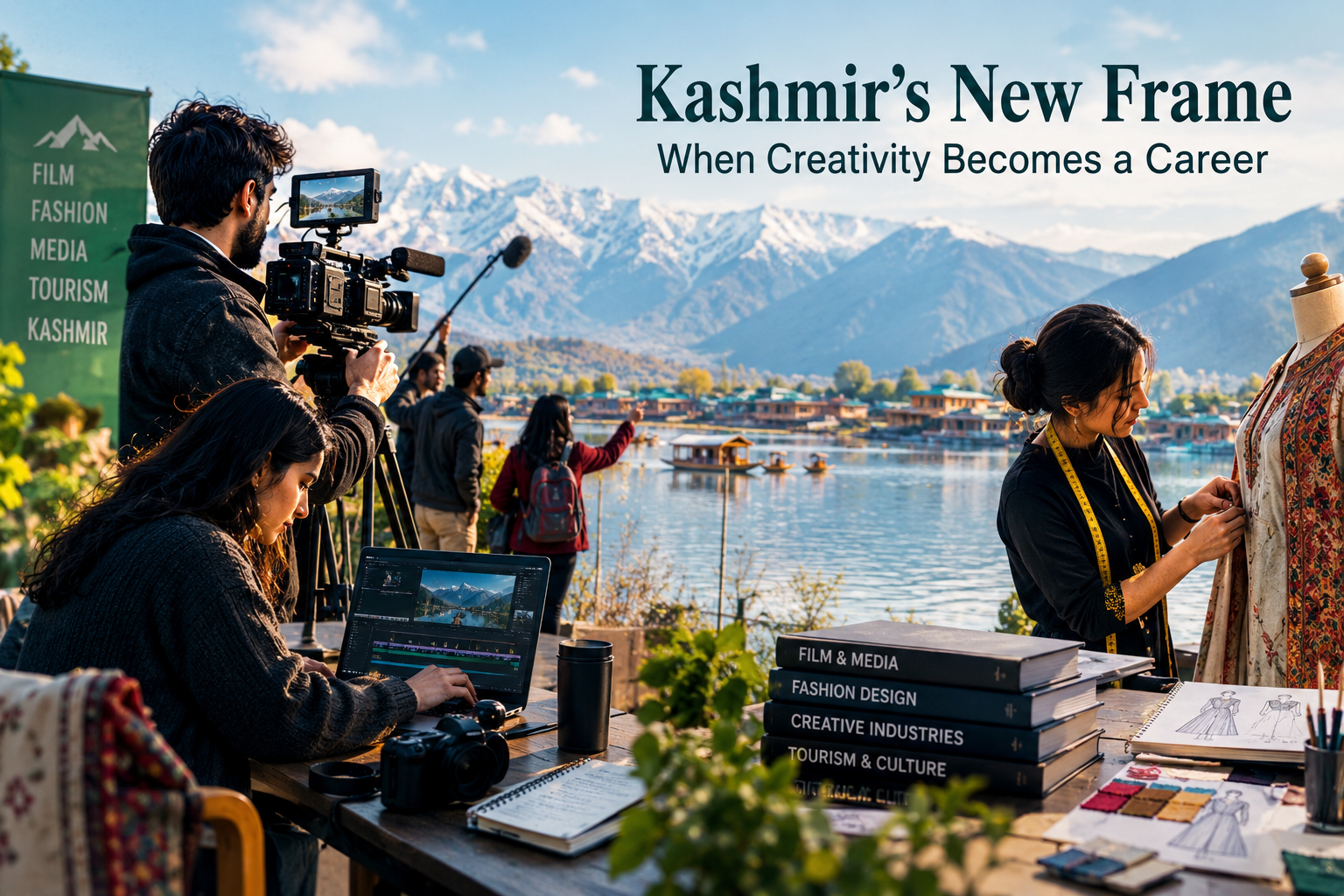
Sheikh Sameer
From a visit to NIFT Srinagar to the arrival of an international film festival, a larger question emerges: can fashion and cinema open a new world of opportunities for Kashmir’s young talent?
About a month ago, I had an opportunity to visit the National Institute of Fashion Technology (NIFT), Budgam.
As I entered the sprawling campus, my first reaction was one of genuine amazement. The infrastructure, architecture and facilities were impressive. For a place in Kashmir, it was encouraging to see an institution of such stature dedicated to creativity, fashion, design and related disciplines.
But my perspective began to change as I interacted with some of the students.
Many of them were from outside Kashmir. They had come here with dreams of building careers in fashion, design and the creative industries. Their confidence and clarity about their future were noticeable.
And somewhere during those conversations, a question began troubling me.
What about the local students?
Here was an institution counted among India’s leading NIFT campuses, offering exposure to a rapidly expanding creative industry. Yet, for many local youngsters, the road from education to a sustainable career appeared far less certain.
The problem, I felt, was not necessarily a lack of talent.
It was the ecosystem.
Kashmir has never suffered from a shortage of imagination. It has artists, writers, photographers, designers, storytellers and young people who are fascinated by fashion, cinema, music and digital media.
What it has lacked, for various reasons, is a sufficiently developed commercial ecosystem capable of turning that talent into livelihoods.
That thought stayed with me.
Then, last week, I heard about the J&K International Film Festival being organised in Kashmir.
My first reaction was not simply excitement about another festival.
It was appreciation for those who had taken the initiative.
Because suddenly, the question that had occurred to me at NIFT seemed much bigger.
If fashion and film industries genuinely begin taking root in Kashmir, how many of our aspiring young people could finally find a career in the very fields they are passionate about?
That is the question worth asking.
Kashmir has always been a natural film set
Kashmir’s relationship with cinema is hardly new.
Its mountains, lakes, meadows, gardens, snow-covered landscapes and traditional settlements have inspired filmmakers for generations. The Valley has repeatedly appeared on the big screen as a place of romance, beauty and wonder.
But there is a fundamental difference between being a location for films and becoming part of the film industry.
For decades, Kashmir has largely provided the backdrop.
The bigger opportunity is to provide the people behind the camera as well.
The first-ever J&K International Film Festival appears to be opening that possibility.
With around 1,100 entries reportedly received from 92 countries and 135 films shortlisted, the festival has already attracted international attention.
Filmmakers, delegates, jury members and cinema professionals arriving in Kashmir will see far more than mountains and landscapes.
They will encounter a society, a culture and a generation of young people who want to participate in the creative economy.
And that interaction could have consequences far beyond the festival itself.
What happens when the cameras arrive?
When a film crew comes to Kashmir, it does not arrive with only actors and a director.
It needs dozens of people.
Production assistants.
Location scouts.
Drivers.
Translators.
Local coordinators.
Cameramen.
Sound technicians.
Lighting assistants.
Makeup artists.
Costume suppliers.
Caterers.
Hotel staff.
Researchers.
Editors.
Designers.
Security personnel.
The list goes on.
A young Kashmiri graduate may not become a film director immediately, but he or she could become a production coordinator, location manager, assistant editor or cinematography trainee.
Someone studying journalism could work on documentary production.
A photography enthusiast could move towards cinematography.
A computer graduate could specialise in editing, animation or visual effects.
A person with knowledge of local languages and culture could become an invaluable cultural consultant or location fixer.
The industry, therefore, has the potential to create a much wider employment ecosystem than the word “cinema” initially suggests.
The same question applies to fashion
My experience at NIFT made me think about this in a similar way.
Fashion is not simply about clothes.
It encompasses design, textiles, photography, modelling, merchandising, marketing, retail, digital content, branding and entrepreneurship.
Kashmir already possesses a remarkable cultural foundation for such an industry—traditional craftsmanship, embroidery, wool, carpets, shawls, papier-mâché, woodwork and a rich aesthetic heritage.
What is missing is a stronger bridge between that heritage and the contemporary commercial world.
Imagine a young Kashmiri designer collaborating with local artisans to create a modern collection.
Imagine fashion photographers working with local models.
Imagine digital creators promoting Kashmiri design globally.
Imagine graduates establishing small fashion labels instead of waiting for conventional employment.
The raw material already exists.
What is needed is opportunity, exposure, professional networks and markets.
The film festival could be the beginning, not the destination
This is why the International Film Festival deserves to be looked at beyond the red carpet.
The festival’s real success should not be measured only by the number of films screened, celebrities who attend or headlines generated.
Its deeper success should be measured by what remains after everyone goes home.
Does a filmmaker return to Kashmir to shoot a feature?
Does a production company establish a local presence?
Does a young student receive an internship?
Does a local technician get hired?
Does a new location-management company emerge?
Does a young editor find regular work?
Does a tourism entrepreneur create film-location tours?
Does a local entrepreneur begin supplying equipment, costumes or props?
If the answer to some of these questions becomes yes, the festival will have achieved something far greater than a successful cultural event.
It will have planted the seeds of an industry.
From unemployed graduate to creative entrepreneur
For Kashmir’s educated youth, this could be particularly important.
The traditional idea of employment often revolves around securing a government job, joining a bank, entering a conventional profession or finding work outside the region.
But the world of work is changing.
Creative industries are increasingly connected with technology, tourism, digital platforms and global markets.
A young person sitting in Srinagar can edit a film produced in another country.
A designer can sell a product internationally through digital platforms.
A photographer can work for clients thousands of kilometres away.
A filmmaker can tell a Kashmiri story to a global audience.
The challenge is to develop the skills and networks that make these possibilities real.
Master classes can become classrooms without walls
The master classes, panels and student interactions associated with the film festival could therefore be extremely valuable.
For young people, these should not simply be opportunities to see well-known filmmakers.
They should be treated as professional classrooms.
Ask questions.
Show your work.
Exchange contacts.
Discuss internships.
Understand how productions are financed.
Learn what skills the industry actually needs.
Find out how a short film becomes a professional portfolio.
A single meaningful interaction with an industry professional can sometimes change the direction of a young person’s career.
But young people must also be prepared to seize that opportunity.
Universities need to become part of the ecosystem
Educational institutions should not remain spectators.
Journalism and mass communication departments can collaborate with filmmakers.
Tourism students can develop film-tourism models.
Business students can study the economics of productions.
Art and design students can work on production design.
Literature students can contribute to storytelling and script development.
Computer science and media students can explore editing, animation and visual effects.
Such collaborations would bring something desperately needed into higher education: real-world exposure.
A degree becomes far more valuable when a student can graduate with both a qualification and a portfolio.
The government has a crucial role
No creative industry can grow on enthusiasm alone.
It needs infrastructure, investment, training and a supportive administrative environment.
The reported deployment of 25 JKAS officers as liaison officers for VVIP coordination during the festival indicates serious institutional involvement.
That administrative commitment could become even more significant if it evolves into a broader framework for film production.
Producers need clear permissions, predictable processes, location support, infrastructure and professional coordination.
Most importantly, there should be mechanisms encouraging the hiring and training of local youth.
Bringing films to Kashmir is one thing.
Ensuring Kashmiris benefit from those films is another.
The second must become the goal.
Imagine the ripple effect
Consider a young graduate who volunteers during the festival.
She assists a documentary team.
She attends an editing master class.
She learns basic post-production.
Instead of allowing the experience to end with the festival, she begins practising.
She edits videos for local businesses and independent creators.
Then she gets an opportunity to work as an assistant editor on a regional production.
Eventually, she starts a small post-production company and employs two other young people.
Her journey may appear modest.
But multiply it by 100.
Or 1,000.
That is how a creative economy begins.
Kashmir should not only be a beautiful frame
There is something symbolic about all this.
For decades, Kashmir has been admired through photographs and films produced by others.
The mountains were photographed.
The lakes were filmed.
The gardens became cinematic locations.
The landscapes became famous.
But perhaps the next chapter should be about the people behind those frames.
Kashmir’s young people should not merely be extras in someone else’s story.
They can be cinematographers, directors, editors, designers, producers, entrepreneurs, photographers, writers and storytellers.
They can build companies here.
They can create jobs here.
And they can tell Kashmir’s stories in their own voices.
The opportunity is real—but it needs nurturing
It would be unrealistic to assume that one film festival will suddenly solve Kashmir’s unemployment problem.
It will not.
Nor will every NIFT graduate become a successful fashion entrepreneur or every film enthusiast become a filmmaker.
But industries are rarely created overnight.
They begin with small opportunities.
A festival.
A workshop.
An internship.
A first assignment.
A professional contact.
A local production.
A small business.
And then another.
The important thing is to create a continuous chain connecting education → skills → exposure → employment → entrepreneurship.
That is where institutions such as NIFT and initiatives such as an international film festival can become transformative.
The frame is set
My visit to NIFT a month ago left me thinking about how much creative potential exists in Kashmir and how little of it is connected to sustainable careers.
The arrival of an international film festival has made that question even more relevant.
For those who have taken the initiative to bring international cinema to Kashmir, appreciation is due—not simply for organising an event, but for opening a conversation about what Kashmir’s creative future could look like.
The festival may last for a few days.
The opportunity it represents could last much longer.
If Kashmir succeeds in developing a genuine ecosystem around cinema, fashion, design, tourism and digital creativity, its educated youth could discover something beyond the conventional search for employment: the possibility of becoming creators, professionals and entrepreneurs in their own homeland.
Kashmir already has the landscapes.
It has the culture.
It has the talent.
It has young people hungry for opportunity.
What it needs now is an ecosystem that brings these elements together.
Perhaps the real story of the J&K International Film Festival will not be the films screened in Srinagar or Gulmarg.
Perhaps it will be the young Kashmiri who walks into the festival without a job and walks out with an idea, a skill, a contact or an opportunity.
Because when the cameras finally arrive in Kashmir, the greatest achievement would be to ensure that local youth are not merely standing in front of them—but working behind them.
The frame is ready. The next story could belong to Kashmir’s youth.


 The Kashmir Dialogues