Sheikh Sameer
Sheikh Sameer
In the quiet corners of Kashmir’s villages—amid snow-covered paths, rugged terrains, and scattered habitations—there exists a workforce that rarely makes headlines but forms the backbone of grassroots welfare. These are the Anganwadi workers: women who serve as caregivers, educators, nutrition providers, health facilitators, and social mobilizers—all rolled into one.
Yet, despite their indispensable role, Anganwadi workers in Jammu and Kashmir continue to fight a long, exhausting battle—not just for better wages, but for dignity, recognition, and basic rights.
The Invisible Backbone of Welfare
Anganwadi workers operate under India’s flagship child welfare framework, the Integrated Child Development Services (ICDS). Their responsibilities are vast and critical:
Providing supplementary nutrition to children and pregnant women
Conducting pre-school education
Spreading awareness on health and hygiene
Assisting in immunization and health check-ups
In Jammu and Kashmir alone, there are over 28,000 Anganwadi workers and nearly an equal number of helpers, forming one of the largest grassroots welfare networks in the region.
They are, quite literally, the first point of contact between the state and its most vulnerable citizens.
A Day in the Life: More Than a Job
Consider the routine of an Anganwadi worker in a remote village of Kupwara or Kulgam.
She wakes up early, manages her household, and then walks miles—sometimes through snow or rain—to reach the Anganwadi center. There, she prepares meals for children, records data, counsels mothers, and ensures that no child is left malnourished.
In many cases, she even visits homes:
To check on pregnant women
To ensure children are vaccinated
To convince reluctant families to adopt better health practices
This is not just a job—it is a lifelong commitment to community welfare.
The Harsh Reality: Low Pay, High Responsibility
Despite their immense contribution, Anganwadi workers remain grossly underpaid.
The central honorarium is around ₹4,500, with small incentives.
In Jammu and Kashmir, an additional ₹600 top-up is provided—one of the lowest in India
In reality, many workers earn around ₹5,000–₹5,100 per month.
This income is barely sufficient to sustain a household, let alone compensate for the responsibilities they shoulder.
As one worker Kawsar put it:
“The work we do is far more than what we are paid for.”
Delayed Salaries and Financial Struggles
If low pay wasn’t enough, delays in salary payments have added to their hardships.
In recent protests in Srinagar, Anganwadi workers highlighted:
Pending wages for months
Lack of financial stability
Inability to meet basic household expenses.
Imagine working daily, fulfilling critical public duties, yet not knowing when your salary will arrive.
For many workers, this uncertainty translates into:
Borrowing money for daily needs
Delayed education of their children
Compromised healthcare for their families
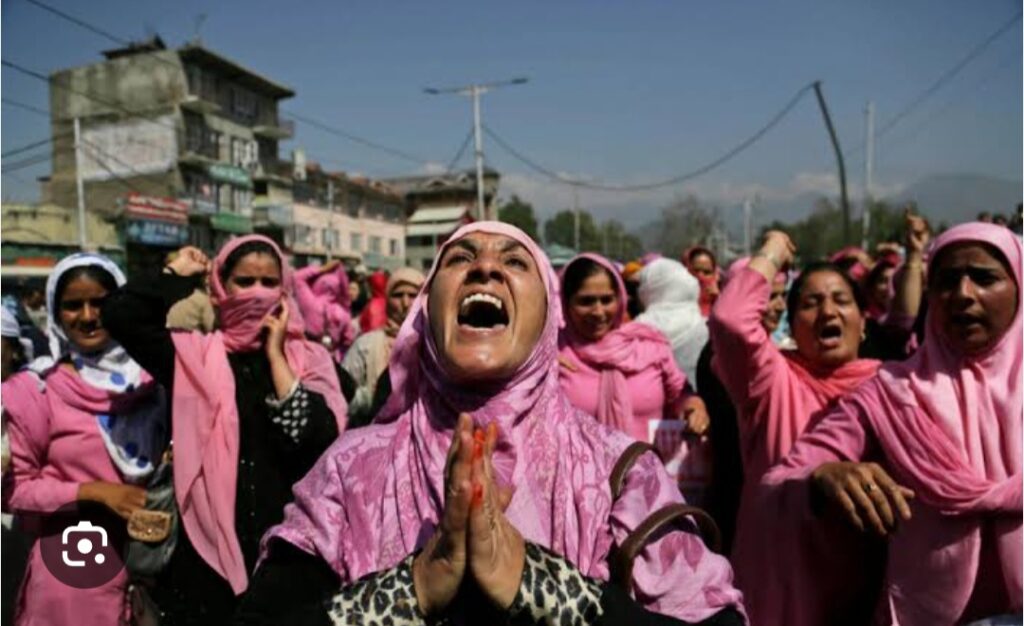
Protests: Voices for Justice
Over the years, Anganwadi workers in Kashmir have repeatedly taken to the streets—not as agitators, but as individuals demanding what is rightfully theirs.
In one such instance, in 2025 thousands of workers staged protests, demanding:
Increase in honorarium
Regularization of services
Pension benefits
Promotion opportunities.
More recently, protests in Srinagar again highlighted similar demands, showing that little has changed over the years.
These protests are not just about money—they are about recognition and respect.
“Volunteers” or Workers? The Identity Crisis
One of the most critical issues is the classification of Anganwadi workers as “honorary workers” or “volunteers” rather than government employees.
This classification has serious implications:
No job security
No pension benefits
No fixed salary structure
Limited legal protection
Despite working full-time and performing essential public duties, they are denied the status of formal employees.
This contradiction lies at the heart of their struggle.
Overburdened and Undervalued
The workload of Anganwadi workers has increased significantly over the years.
They are now required to:
Maintain digital records
Upload data on government portals
Conduct surveys and campaigns
Participate in additional government programs
Yet, this expansion of duties has not been matched with better pay or improved working conditions.
In many cases, they lack:
Basic infrastructure at Anganwadi centers
Adequate teaching materials
Proper storage for nutrition supplies
They are expected to deliver outcomes without being given the necessary tools.
The Human Cost: Stories from the Ground
Behind every statistic is a human story.
Example 1: The Snowbound Worker
In north Kashmir, a worker Aasiya (Name Changed) walks several kilometers through snow to ensure children receive their daily nutrition. She does this despite irregular wages and lack of transportation.
Example 2: The Graduate Worker
Many Anganwadi workers are educated—some even graduates—but remain stuck in low-paying roles with no career progression
Example 3: The Mother Who Serves Others First
A worker ensures every child in her center is fed, even if it means sacrificing her own meal.
These stories highlight not just struggle, but extraordinary commitment.
Why Their Work Matters
Anganwadi workers are not just service providers—they are nation builders.
Their work directly impacts:
Reduction in child malnutrition
Improvement in maternal health
Early childhood education outcomes
In regions like Kashmir, where accessibility is a challenge, their role becomes even more critical.
They bridge the gap between:
Government schemes and people
Policy and implementation
Hope and reality
Government Efforts and Gaps
There have been efforts to strengthen the Anganwadi system through initiatives like:
POSHAN Abhiyaan
Mission Saksham Anganwadi
However, implementation gaps remain:
Inadequate financial incentives
Poor infrastructure
Lack of long-term policy reforms
Without addressing these structural issues, the system risks losing its most valuable asset—its workers.
The Gender Dimension
It is important to note that Anganwadi workers are predominantly women.
Their struggle is not just economic—it is also gendered.
They juggle:
Household responsibilities
Social expectations
Professional duties
Yet, their work is often undervalued because it falls within the broader category of “care work,” which has historically been underrecognized.
The Fight for Dignity
At its core, the struggle of Anganwadi workers is about dignity.
They are not asking for charity—they are demanding:
Fair wages
Job security
Respect for their work
As one powerful line puts it:
Paying Anganwadi workers with dignity is not charity—it is justice.
One of the worker suggests that
To address the concerns meaningfully, several steps are necessary:
1. Regularization of Services
Recognizing Anganwadi workers as formal employees with legal rights.
2. Fair Compensation
Revising honorarium to reflect their workload and responsibilities.
3. Timely Salary Payments
Ensuring financial stability through regular disbursement.
4. Social Security Benefits
Introducing pensions, insurance, and healthcare support.
5. Infrastructure Development
Improving Anganwadi centers with proper facilities and resources.
Anganwadi workers in Kashmir are more than just frontline workers—they are the silent architects of a healthier, more equitable society.
They nurture the future, often at the cost of their own present.
Yet, their struggle continues—a struggle not just for better pay, but for recognition, respect, and dignity.
In a region that has witnessed decades of conflict and challenges, these women stand as symbols of resilience and hope.
It is time their voices are not just heard—but acted upon.
Because empowering Anganwadi workers is not just a welfare measure—it is an investment in the future of Kashmir.