Sheikh Sameer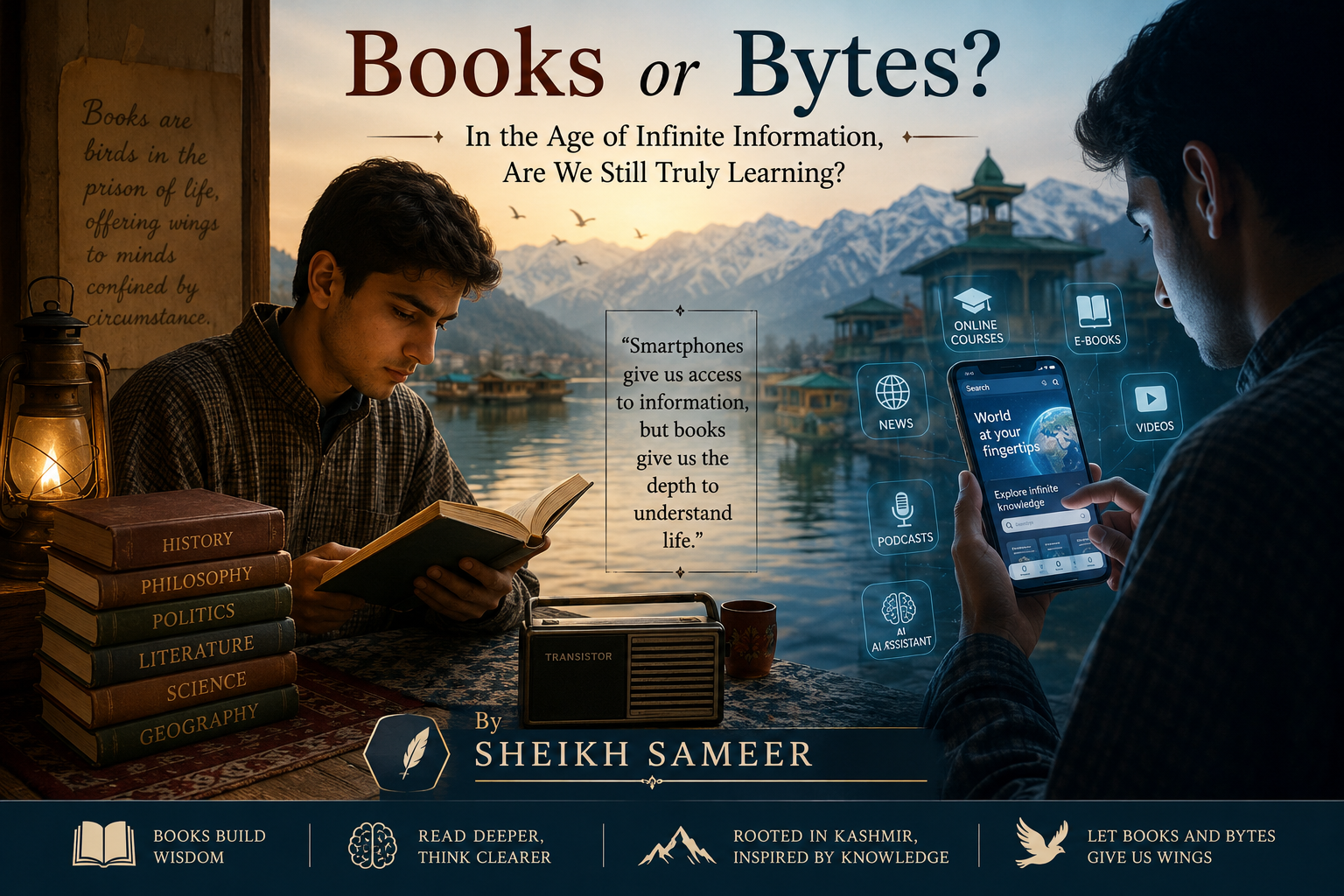
“It is said that books are birds in the prison of life, offering wings to minds confined by circumstance. But does this hold true in today’s age of smartphones and instant internet feeds, where knowledge is hyper-accessible yet strangely transient?”
This question is no longer philosophical—it is deeply relevant to the way our society learns, thinks, and remembers. We live in an era where almost every answer is a few taps away. Yet despite having access to more information than any previous generation, many of us struggle to concentrate, reflect, and retain what we read.
Perhaps the challenge of our times is not a lack of knowledge but a lack of meaningful engagement with it.
A Fine Evening in 2002
It was a fine, serene evening in the year 2002. My uncle—now a settled government employee—picked up a thick, heavily annotated book and a small portable transistor radio before walking towards the peaceful outskirts of our village. The sun slowly disappeared behind the snow-covered mountains, painting the sky with shades of orange and crimson. Farmers were returning home after a day’s work, children were playing in the narrow lanes, and the evening breeze carried the scent of fresh earth.
For my uncle, however, the day had only just entered its most meaningful phase.
He found a quiet place beneath a tall walnut tree, where only the rustling leaves and distant songs from the radio accompanied him. For hours, he remained immersed in the pages of that book. The world around him faded away.
When he finally returned home after sunset, the village had fallen silent. In his hand was the same thick volume, with a simple cotton thread carefully marking the page where he had stopped.
That book was much more than paper and ink. It was his teacher, his closest companion, and his passport to a larger world. Preparing for competitive examinations was not easy in those days. Libraries were scarce, internet connectivity was almost non-existent, and study material had to be borrowed, preserved, and read repeatedly.
He studied beside the warm bukhari during harsh winter nights, under dim electric bulbs during frequent power cuts, and while travelling on crowded buses between villages and towns. Every spare moment became an opportunity to read.
But what made those evenings even more memorable was what happened after he closed the book.
During dinner, over steaming cups of traditional noon chai and simple home-cooked meals, he would narrate everything he had learnt that day. Conversations revolved around history, politics, economics, geography, philosophy, and administration. We listened with fascination as distant countries, historical empires, scientific discoveries, and constitutional debates came alive through his words.
Books had given him wings—and through his storytelling, they gave the rest of us the courage to dream beyond the boundaries of our village.
The Shift: From Pages to Pixels
Fast forward to present-day Kashmir, and that scene feels almost nostalgic.
Today’s young student no longer needs to carry heavy books to lonely fields. A smartphone weighing less than 200 grams can store an entire library. Digital classrooms, online lectures, artificial intelligence, e-books, podcasts, educational videos, and research papers are available instantly.
Information has become democratised.
A student in Gurez, Kupwara, Shopian, or Kishtwar can access lectures from the world’s finest universities. A UPSC aspirant in Anantnag can download the same study material available in Delhi. Farmers learn modern techniques through YouTube. Entrepreneurs discover marketing strategies on social media. Medical awareness reaches villages that once had little access to healthcare information.
Technology has undoubtedly broken geographical barriers.
Yet a deeper question remains.
Have smartphones given us stronger wings—or have they merely changed the design of our cage?
The Illusion of Knowing
Never before has information been so abundant.
Ironically, genuine understanding often feels increasingly scarce.
Scrolling through hundreds of posts creates the comforting illusion that we are constantly learning. We consume headlines without reading articles. We watch one-minute explainers on topics that deserve hours of thoughtful study. We save educational videos with the intention of watching them later—only to forget them forever.
Our minds become warehouses of fragments rather than libraries of ideas.
Psychologists describe this as the “illusion of knowledge.” Because information is readily available, our brains feel less urgency to remember it. We know where to search, but we no longer strive to truly understand.
Reading a book requires patience.
Scrolling requires only a thumb.
One builds comprehension.
The other often encourages consumption.
The Lost Art of Deep Reading
Books ask something from their readers that smartphones rarely do.
They demand uninterrupted attention.
A novel slowly introduces its characters. A history book patiently builds context. A philosophical work encourages reflection before moving to the next chapter. Even difficult passages become opportunities for critical thinking.
Digital platforms operate differently.
Notifications interrupt concentration.
Videos autoplay before reflection begins.
Algorithms continuously tempt users toward newer, shorter, and more stimulating content.
As attention spans shrink, sustained reading becomes increasingly difficult.
Many young people confess they struggle to read even twenty pages of a book without checking their phones.
The problem is not intelligence.
It is constant interruption.
Kashmir’s Changing Reading Culture
Kashmir has historically nurtured a rich literary tradition.
From the timeless verses of Lal Ded and Sheikh-ul-Alam to Persian scholars, Urdu poets, Arabic theologians, and contemporary Kashmiri writers, books have long shaped the region’s intellectual identity.
Public libraries once attracted students preparing for civil services and university examinations. Bookshops in Srinagar remained crowded during examination seasons. Newspapers were read collectively in village tea stalls, where discussions often lasted longer than the articles themselves.
Today, many of those conversations have migrated to social media.
While digital platforms have expanded participation, they have also shortened attention.
Opinion often replaces study.
Reaction frequently replaces reflection.
What We Gain from Technology
It would be unfair—and inaccurate—to romanticise the past while dismissing technology.
Smartphones have transformed education in remarkable ways.
Students from remote villages now attend online coaching classes without relocating to expensive cities.
Researchers collaborate globally.
Language barriers have reduced through translation tools.
Digital archives preserve rare manuscripts that might otherwise disappear.
Artificial intelligence helps summarise complex concepts, generate practice questions, and personalise learning.
During natural disasters, pandemics, or periods of disruption, online education has kept learning alive.
Technology is not the enemy.
Misuse is.
A smartphone can distract us—or educate us.
The choice ultimately rests with its user.
The Cost of Constant Connectivity
However, every technological revolution carries hidden costs.
Our relationship with silence has changed.
Waiting has disappeared.
Boredom has become intolerable.
Moments once spent thinking are now spent scrolling.
Psychologists increasingly warn that continuous digital stimulation affects concentration, emotional regulation, memory, and sleep quality. Social media platforms compete aggressively for attention because attention has become one of the world’s most valuable commodities.
When every spare minute is filled with endless scrolling, our minds lose opportunities to process ideas deeply.
Books provide those opportunities.
They slow us down.
They create mental space.
They encourage imagination rather than constant stimulation.
Books Teach More Than Information
A good book rarely offers only facts.
It teaches empathy.
Reading a novel allows us to inhabit another person’s life.
Reading history teaches humility.
Reading biographies reveals that success rarely arrives overnight.
Reading philosophy sharpens reasoning.
Reading literature enriches language.
Books cultivate emotional intelligence alongside intellectual growth.
Screens often provide answers.
Books teach us how to ask better questions.
Finding Balance in the Digital Age
The debate, therefore, should not be “books versus smartphones.”
It should be books and smartphones used wisely.
Technology can introduce us to knowledge.
Books help us internalise it.
Digital platforms are excellent starting points.
Books remain unmatched destinations.
A student may watch a fifteen-minute video explaining the Indian Constitution—but understanding its philosophy requires reading, reflection, and discussion.
Similarly, a documentary may inspire curiosity about Kashmir’s history, but only detailed reading reveals the complexities hidden beneath simplified narratives.
The future belongs not to those who reject technology but to those who combine digital efficiency with intellectual depth.
Reviving the Reading Habit
Families, schools, colleges, and communities all have a role to play.
Parents can replace occasional screen time with shared reading sessions.
Schools can encourage book discussions rather than rote memorisation.
Libraries can become community spaces once again.
Book fairs, literary festivals, reading clubs, and local author interactions can revive curiosity among younger generations.
Even dedicating thirty uninterrupted minutes each day to reading can gradually transform one’s thinking.
The goal is not to abandon technology but to ensure it remains a servant rather than becoming a master.
The Wings We Choose
Whenever I remember that quiet evening in 2002, I realise my uncle’s greatest achievement was not merely securing a government job.
It was developing the discipline to sit alone with a book for hours, allowing ideas to shape his character, broaden his perspective, and strengthen his judgement.
Today’s generation possesses tools he could never have imagined.
The internet has opened doors that once seemed permanently closed.
Artificial intelligence can explain complex subjects within seconds.
Entire libraries fit inside a smartphone.
Yet no technology can replace curiosity.
No algorithm can substitute wisdom.
No notification can recreate the quiet companionship of a good book.
Books may no longer be the only birds capable of carrying us beyond the prison of circumstance, but they remain among the strongest. Smartphones can certainly become wings too—provided they are used not merely to consume information, but to seek understanding.
In the end, the question is not whether books have lost their relevance.
The real question is whether we still possess the patience to let them transform us.
For knowledge is not measured by how much information we can access.
It is measured by how deeply we understand, how thoughtfully we reflect, and how wisely we live.
And perhaps that is the lesson my uncle unknowingly taught us beneath that walnut tree on a quiet Kashmiri evening many years ago: the strongest wings are not made of paper or pixels, but of disciplined minds that never stop learning.


 The Kashmir Dialogues

 Sheikh Mudasir