Sheikh Sameer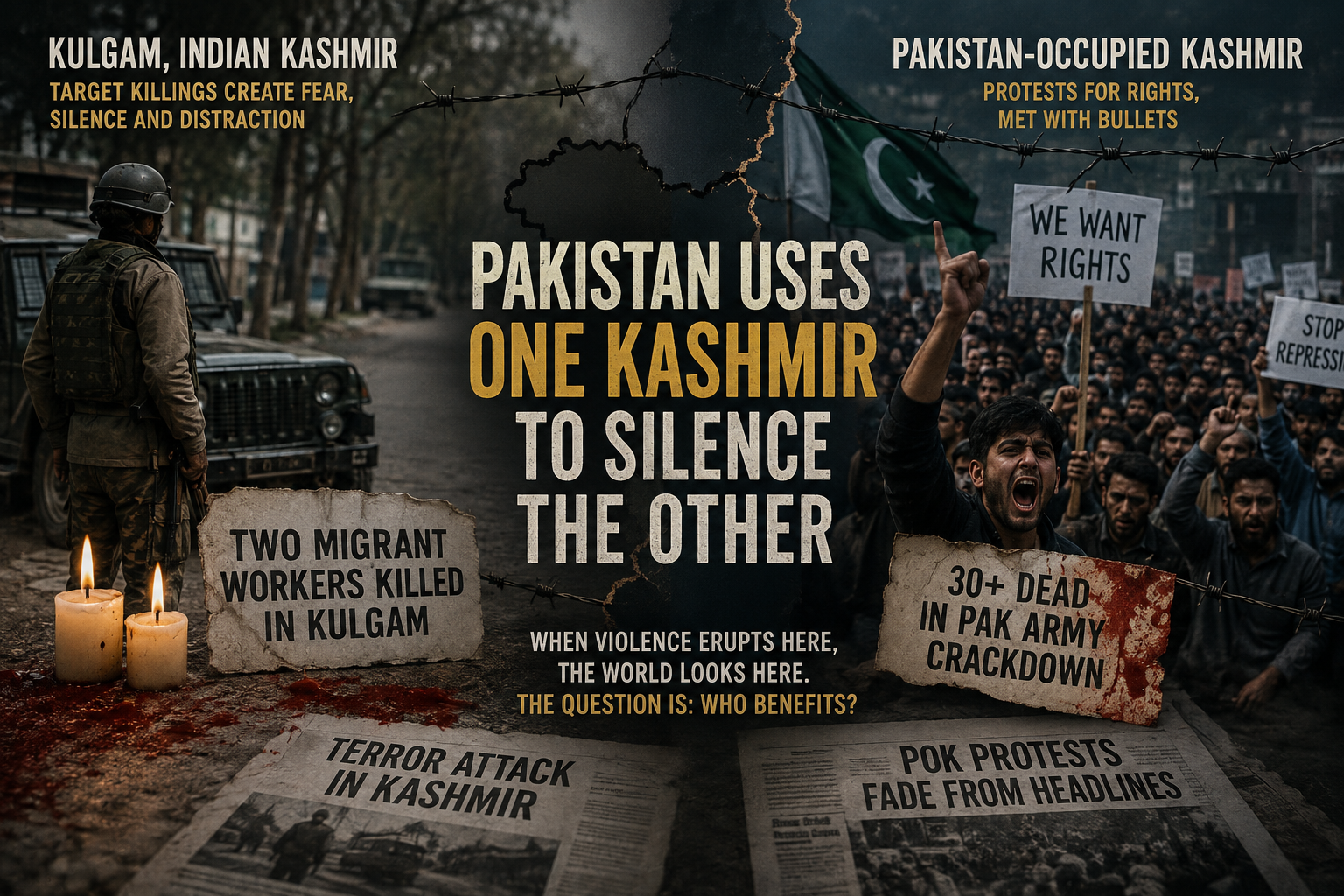
Sometimes, to understand a political event, it is not enough to ask who pulled the trigger.
One must also ask: who benefits from the consequences?
That question becomes particularly important when violence returns to Kashmir at a moment when another Kashmir—Pakistan-administered Jammu and Kashmir—is demanding attention for entirely different reasons.
The recent targeted killing of two migrant workers in Kulgam and a police cop in anantnag has once again pushed terrorism, security and civilian safety in Jammu and Kashmir to the centre of public discussion. At almost the same time, Pakistan-occupied Jammu and Kashmir has been witnessing intense protests, a violent state response and reports of more than 30 deaths.
There is currently no publicly established evidence proving that the Kulgam attack and cop killing was specifically planned to divert attention from the unrest in PoK. Any such conclusion would require a credible investigation and evidence establishing the chain of command behind the attack.
But the coincidence raises a question that is too important to simply dismiss:
When violence erupts in Indian-administered Kashmir just as political anger is growing in Pakistan-administered Kashmir, who benefits from the change in the narrative?
Perhaps the answer lies not in looking at the gunman alone, but in following the consequences of the gunshot.
The story that was beginning to emerge from PoK
Before the Kulgam killings, another Kashmir was demanding the world’s attention.
In Pakistan-administered Kashmir, people were protesting against economic hardship, governance failures, electricity and taxation issues, political grievances and what they viewed as the neglect of their region by Islamabad.
The protests were significant not simply because of their size, but because of where they were happening and whom they were challenging.
For decades, Pakistan has sought to present itself internationally as a supporter of the Kashmiri people’s aspirations.
But when Kashmiris living under Pakistani administration themselves take to the streets against Islamabad, that carefully constructed narrative becomes considerably more complicated.
The international question changes.The world now began asking:
What is Pakistan doing in the Kashmir it administers?
That is an uncomfortable question.
And uncomfortable questions are often the ones political establishments most want to move away from.
Then the headlines change
Now consider what happens after a targeted killing in Kulgam.
The media cycle changes almost instantly.
The headlines are no longer about electricity prices or political representation in PoK.
They become about terrorists.
The conversation shifts towards militant organisations, security forces, infiltration, intelligence failures, civilian safety and India-Pakistan tensions.
Television studios return to the familiar Kashmir security debate.
Social media fills with images and reactions.
Political leaders issue statements.
Security agencies launch operations.
And international observers once again look towards Indian-administered Jammu and Kashmir.
None of this proves that the Kulgam attack was designed to produce that outcome.
But it demonstrates something strategically important:
terrorism has the power to change the subject.
And in politics, changing the subject can sometimes be as valuable as winning an argument.
Follow the benefit
This is where the old investigative question—cui bono, who benefits?—becomes useful.
Suppose a terrorist attack takes place.
The immediate victims are civilians.
The attackers may be killed or arrested.
Security agencies launch investigations.
But the political consequences extend much further.
Who benefits when fear returns to Kashmir?
Who benefits when migrant workers feel unsafe?
Who benefits when tourists become uncertain?
Who benefits when communal suspicion increases?
Who benefits when international attention moves from protests in PoK back to militancy in Indian-administered Kashmir?
Who benefits when the phrase “Kashmir conflict” once again dominates international headlines rather than “Kashmiri protests against Pakistan”?
These questions do not provide evidence of responsibility.
But they help identify strategic beneficiaries.
And strategic beneficiaries deserve scrutiny.
The first beneficiary: the terrorist ecosystem itself
The most obvious beneficiaries are terror organisations.
Their objective is not merely to kill.
Terrorist organisations survive by creating an atmosphere in which people believe that normal life can be disrupted at any moment. And all of us who sponsors these terror groups.
A targeted killing of a civilian communicates a message far beyond the victim.
It tells migrant workers that they may not be safe.
It tells businesses that stability is fragile.
It tells tourists that violence can return.
It tells local communities that the gun remains relevant.
And it tells the wider world that Kashmir can still be portrayed as a zone of conflict.
The terrorist does not need to control a town to achieve this.
A single bullet can create a much larger psychological footprint.
The second beneficiary: those who want Kashmir to remain trapped in a security narrative
For years, Pakistan has discussed Kashmir internationally through a vocabulary dominated by conflict, terrorism, human rights concerns, military deployments and people’s aspirations for azadi.
That narrative has political value for actors who want Kashmir to remain an unresolved international dispute.
Every major terrorist attack revives that framework.
The discussion becomes less about governance, development and ordinary civilian life and more about security.
The question of whether Kashmir is becoming more peaceful can be replaced by the question of whether terrorism is returning.
That is a powerful narrative reversal.
And it is precisely why every attack must be examined not only for its immediate perpetrators but also for its wider consequences.
The third beneficiary: anyone who wants the PoK protests forgotten
This is perhaps the most important question.
Imagine two headlines competing for international attention.
The first says:
“Kashmiris protest against Pakistan-administered authorities amid deadly clashes.”
The second says:
“Two civilians shot dead in targeted attack in Kashmir.”
Which story is more likely to dominate television screens, social media and international security discussions?
The answer is obvious.
The second story is immediate, violent and visually compelling.
It generates fear.
It creates breaking news.
It produces dramatic political reactions.
The first story requires context.
It requires understanding local grievances.
It requires examining governance in PoK.
It requires asking uncomfortable questions about Islamabad.
This is the fundamental power of narrative diversion.
A complicated political crisis can be displaced by a simple security headline.
Why migrant workers?
The selection of migrant workers is itself significant from a psychological perspective.
They are among the most vulnerable people in Kashmir.
They come from different parts of India seeking employment and livelihood. They generally have no role in the political dispute.
That makes them an attractive target for anyone seeking maximum psychological impact from minimum operational effort.
Their killing can generate fear far beyond their immediate communities.
A worker in another district begins wondering whether it is safe to remain.
A family thousands of kilometres away becomes anxious.
Employers worry.
Local residents fear that communal tensions may follow.
And social media amplifies every rumour.
In this way, the killing of two individuals can produce a much larger political and economic effect.
The target, therefore, may not only be the individual.
The target may be confidence itself.
Tourism is another target
There is another reason targeted killings can have disproportionate consequences in Kashmir.
Tourism depends heavily on perception.
A destination can be physically peaceful, but a few violent incidents can alter how outsiders perceive it.
One incident becomes a thousand social-media posts.
One headline becomes a television debate.
One image becomes an international perception.
For a region trying to build tourism, investment and employment, the psychological cost can be enormous.
This is why terrorism can attack an economy without destroying a single hotel.
Fear does the economic damage.
The deeper irony: two Kashmirs, two realities
Perhaps the most important lesson is that Kashmir cannot be reduced to a single narrative.
There is Indian-administered Jammu and Kashmir.
There is Pakistan-administered Jammu and Kashmir.
People on both sides have their own political grievances, aspirations and lived experiences.
Yet the India-Pakistan dispute often attempts to compress these different realities into one convenient geopolitical story.
The protests in PoK challenge that simplification.
They remind the world that people living under Pakistani administration are not merely passive subjects of Islamabad’s Kashmir policy.
They have grievances of their own.
They have political demands of their own.
And they have the right to be heard without their voices being drowned out by events elsewhere.
The real battle may be over attention
The modern wars are no longer fought only with guns.
They are also fought with images, headlines, hashtags and narratives.
A terror attack can become a global story within minutes.
A protest over governance can disappear within hours.
This imbalance gives violence a peculiar political power.
The gunman does not control the newsroom.
But the gunshot can influence what the newsroom discusses.
That is why the aftermath of terrorism matters almost as much as the attack itself.
If an attack causes the world to stop discussing PoK, creates communal polarisation, damages tourism and restores the old security-centric Kashmir narrative, then its impact is far greater than its immediate casualty count.
Whether that outcome was deliberately planned or merely exploited afterwards is a question for intelligence agencies and investigators.
But the outcome itself deserves recognition.
India must not fall into the trap
There is also a lesson for India.
The appropriate response to targeted killings cannot be driven by emotion alone.
Security agencies must identify and dismantle the network behind the attacks.
But politically, India must also resist allowing terrorism to dictate the entire Kashmir narrative.
Kashmir should continue to be discussed in terms of development, tourism, education, employment, governance and the return of normal life.
If every terrorist attack succeeds in resetting the entire conversation around violence, the terrorists gain an important strategic victory.
The answer is therefore not to ignore terrorism.
It is to defeat terrorism without allowing terrorists to define the narrative.
Let both Kashmirs speak
The world can condemn the Kulgam killings and still ask what is happening in Pakistan-administered Kashmir.
It can demand justice for murdered civilians and still demand accountability for deaths during protests in PoK.
There is no contradiction.
Indeed, refusing to connect the two narratives may itself be a mistake.
Because the real issue is not whether one event can be conclusively declared a diversion operation.
The deeper issue is whether the world allows a violent incident in one Kashmir to erase the political grievances emerging in another.
That is the question that deserves attention.
Who benefits when Kashmir becomes synonymous with terrorism again?
Who benefits when migrant workers are frightened away?
Who benefits when tourism suffers?
Who benefits when communal tensions rise?
Who benefits when the international conversation moves from protests against Islamabad to violence in Indian-administered Kashmir?
And finally:
Who benefits when the people protesting in Pakistan-administered Kashmir disappear from the headlines?
These questions should not be answered with speculation.
They should be answered with evidence.
If the Kulgam investigation ultimately uncovers Pakistan-based handlers, their networks must be exposed.
If it establishes a deliberate attempt to exploit the PoK unrest and divert attention, that evidence must be placed before the world.
And if investigators find no such connection, that conclusion must also be respected.
But whatever the investigation reveals, one principle should remain non-negotiable:
One Kashmir must not be allowed to silence the other.
The people of Kulgam deserve justice.
The people protesting in Pakistan-administered Kashmir deserve to be heard.
And neither should become a prop in a geopolitical game in which ordinary Kashmiris pay the price while others control the narrative.
Perhaps that is the most important question for the Kashmir debate today—not simply who benefits from the killing, but who benefits from the silence that follows it?
— The Kashmir Dialogues



 M S Nazki