Sheikh Sameer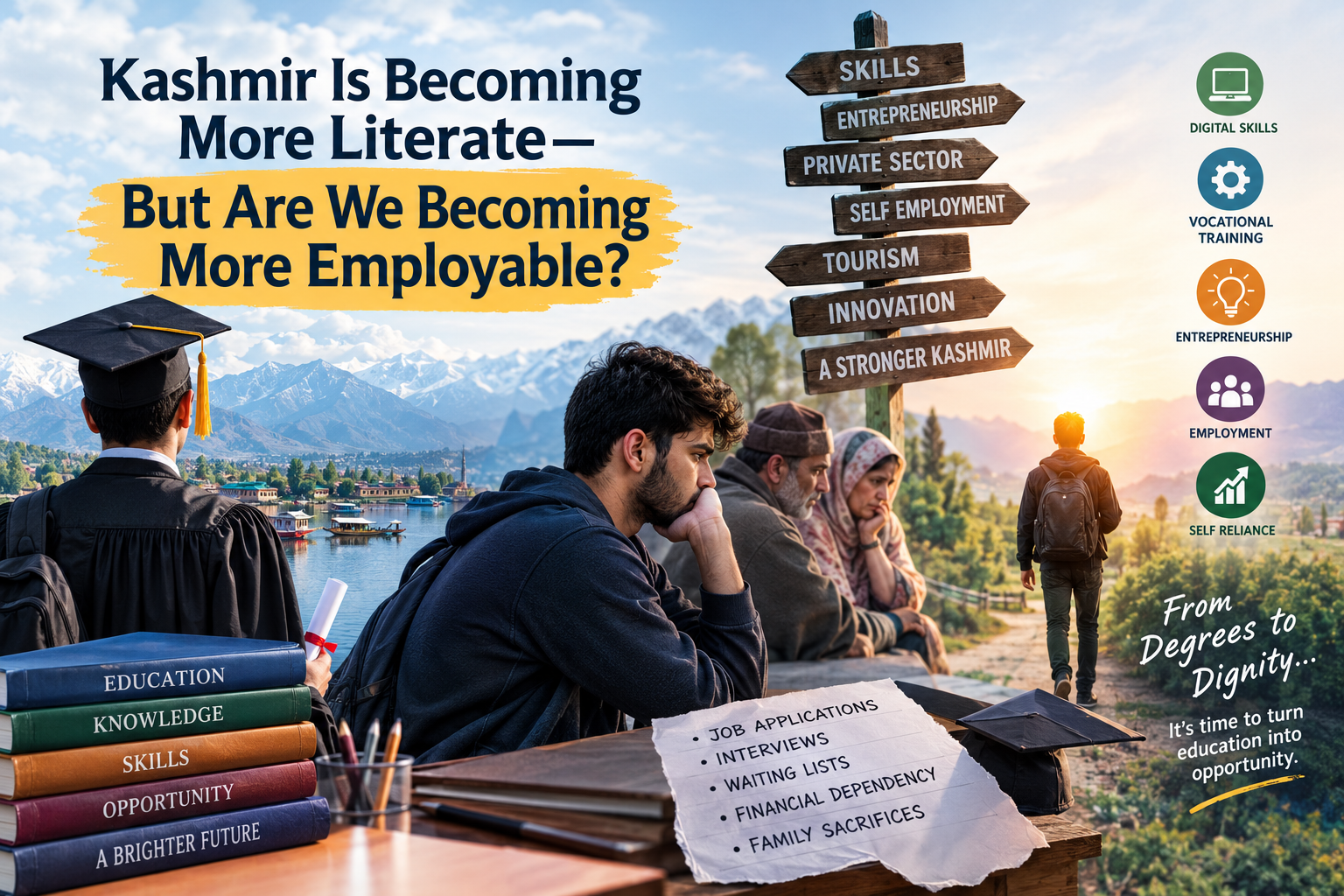
Sheikh Sameer
A few days ago, our Hon’ble Education Minister, Ms Sakeena Itoo, said that “Kashmir is fully literate now.” The statement is undoubtedly a matter of pride. Education is one of the strongest foundations upon which any society can build its future, and achieving universal literacy—or moving decisively towards it—is something that deserves appreciation.
But perhaps this is also the right moment to ask a more uncomfortable question:
Are we becoming more employable at the same pace at which we are becoming educated?
Because literacy is the beginning of education, not its destination. A degree can open a door, but it cannot guarantee that there will be a job waiting on the other side.
Kashmir today presents a paradox. We have more schools, colleges, universities, professional institutions and degree holders than ever before. Our young people are studying longer, competing in examinations, earning postgraduate qualifications and collecting certificates. Yet thousands of educated young men and women continue to struggle for employment.
For many families, this contradiction has become painfully personal.
An educated young person in his or her late twenties or early thirties sitting at home, dependent on parents for everyday expenses, is not merely an employment statistic. Behind that person is a family that has often spent years sacrificing its own needs to finance education.
When education becomes a family burden
In Kashmir, parents have traditionally regarded education as the most valuable investment they can make in their children.
They sell agricultural produce, borrow money, cut household expenditure and postpone their own requirements to pay school and college fees. Many parents quietly sacrifice their medicines, clothing, travel and other essential needs so that their children can continue studying.
The expectation is simple:
“Let the child study today; tomorrow the child will stand on his or her own feet.”
But what happens when tomorrow keeps getting postponed?
It is deeply painful for a parent to see a son or daughter with a university degree still asking for money for basic expenses. And it is equally embarrassing for an educated young person in his or her early thirties to stretch a hand towards ageing parents for financial support.
The situation becomes even more difficult for those who have lost their parents.
Many such educated youngsters have no financial safety net. They end up accepting whatever work they can find—often in private establishments for meagre salaries, temporary positions without security, or even manual labour.
There is nothing shameful about labour. There is dignity in every honest profession. The real tragedy is when a person spends 15 or 20 years acquiring education but emerges without the practical skills necessary to earn a sustainable livelihood.
That is where we need to examine ourselves.
Degrees are increasing. But are skills increasing?
The modern employment market does not simply ask whether a person is educated. It asks:
Can you communicate?
Can you use technology?
Can you analyse information?
Can you solve problems?
Can you sell something?
Can you manage a business?
Can you work remotely?
Can you operate modern machinery?
Can you code?
Can you design?
Can you provide professional services?
Can you create employment rather than merely seek it?
These are questions that a traditional degree may not answer.
A graduate may know the theories taught in a classroom but remain unfamiliar with accounting software, digital marketing, artificial intelligence, data analysis, professional communication, modern agriculture, tourism management, logistics, electrical systems, healthcare technology or other practical skills demanded by today’s economy.
This is the gap between being educated and being employable.
Kashmir’s educated unemployment is not simply an employment problem
We should also understand that unemployment among educated youth is not merely an economic issue. It has social and psychological consequences.
A young person who remains unemployed for years can gradually lose confidence. Repeated applications, examinations, interviews and waiting lists can create frustration.
When a young graduate sees someone with fewer qualifications earning independently while he or she remains dependent on family, the feeling of failure can become overwhelming.
And there is another dimension that we rarely discuss openly: social expectations.
In Kashmir, education is often linked to status. Families encourage children to pursue conventional degrees—BA, MA, B.Ed, engineering, medicine, law and other qualifications—because these are traditionally considered respectable career paths.
But the economy does not create government jobs at the same rate at which universities create graduates.
The result is a queue.
Thousands compete for a handful of vacancies, while opportunities in other sectors remain underdeveloped or underutilised.
Government jobs cannot be the only destination
One of the biggest changes Kashmir needs is a shift in the definition of a successful career.
For decades, a government job has been regarded as the ultimate destination for an educated young person. Stability, social status, pension-related expectations and job security have made government employment extremely attractive.
There is nothing wrong with aspiring for a government job.
The problem begins when an entire generation is taught to believe that a government job is the only respectable form of employment.
A healthy economy cannot function like that.
We need entrepreneurs, skilled technicians, hospitality professionals, accountants, digital creators, designers, mechanics, electricians, healthcare workers, researchers, agricultural specialists, tour operators, logistics professionals, software developers and thousands of other skilled workers.
A young Kashmiri should not feel that accepting a skilled private-sector job is somehow inferior to waiting indefinitely for a government appointment.
We need to move from job seekers to job creators
This is where entrepreneurship becomes important.
Kashmir has enormous potential in tourism, horticulture, handicrafts, food processing, agriculture, information technology, logistics, renewable energy and the creative economy.
But entrepreneurship cannot simply mean distributing loans.
A young person needs more than capital.
He or she needs mentorship, market access, business training, digital knowledge, accounting skills, branding assistance and an understanding of how to sell products beyond Kashmir.
Giving someone money without giving them the ability to run a sustainable enterprise can turn an employment scheme into another debt burden.
The focus therefore has to shift from “How many loans were distributed?” to “How many sustainable businesses survived after three or five years, and how many jobs did they create?”
That is the real measure of success.
Education itself must change
If Kashmir wants an employable generation, employability must enter the classroom much earlier.
Schools should expose students to practical skills and career possibilities—not merely examination preparation.
Colleges should build stronger connections with industries and local businesses.
Students studying tourism should spend time in hotels and travel companies. Agriculture students should work with modern farming enterprises. Commerce students should learn real accounting systems. Journalism students should work in actual newsrooms. Computer students should build projects for real clients.
Internships should not be treated as ceremonial certificates.
They should be treated as bridges between education and employment.
And vocational education must lose the stigma attached to it.
A young person who becomes an excellent electrician, plumber, automobile technician, carpenter, welder, solar technician or hospitality professional can potentially earn more than a graduate sitting at home waiting for a government vacancy.
The dignity of work must become more important than the prestige attached to a job title.
The private sector also has a responsibility
The responsibility does not rest entirely with the government or educational institutions.
Kashmir’s private sector must also grow.
Young people cannot be expected to build their futures around extremely low salaries, insecure employment and limited opportunities for advancement.
Businesses need to invest in their employees and create professional workplaces where skills are rewarded and experience translates into better compensation.
At the same time, young people must also recognise that their first job may not be their final destination.
A modest first salary can sometimes provide something more valuable than money: experience.
The important thing is whether that experience eventually leads somewhere.
We must redefine what literacy means
Perhaps the greatest question is not whether Kashmir is literate.
Perhaps it is:
What kind of literacy do we want?
A person who can read and write is literate.
A person who can think critically, use technology, understand finances, communicate effectively, solve problems and create economic value is more prepared for the modern world.
And a society becomes truly educated when its people can use knowledge to improve their own lives and the lives of others.
Therefore, celebrating universal literacy should not be the conclusion of our educational journey.
It should be the beginning of a much bigger conversation.
The parents who sacrificed everything deserve an answer
Behind Kashmir’s educated unemployed youth are millions of hours of parental sacrifice.
There are mothers who postponed medical treatment to pay college fees.
There are fathers who continued working despite age and illness because their children were still studying.
There are families that borrowed money because they believed education would eventually provide economic independence.
Those sacrifices must not become meaningless.
Our objective should not simply be to produce more graduates.
We must produce graduates who can stand on their own feet.
A degree should not become a certificate of dependency.
It should become a tool for independence.
From literacy to livelihood
Kashmir has every reason to celebrate its educational progress. But celebration should never prevent introspection.
If we have achieved remarkable progress in literacy, the next target should be equally ambitious:
employability.
The question before policymakers, educators, parents and young people is no longer merely, “How many children are going to school?”
It is also:
“What are they learning?”
“What can they do with what they have learned?”
And ultimately:
“Can their education help them earn a dignified livelihood?”
Kashmir’s youth do not merely need certificates. They need opportunities.
They do not merely need examinations. They need skills.
They do not merely need schemes. They need sustainable enterprises.
And they do not merely need jobs. They need dignity, independence and a future in which asking parents for pocket money at the age of thirty is no longer an unavoidable reality.
Literacy tells us that a person can read the world.
Employability gives that person the power to participate in it.
Kashmir may be becoming fully literate.
Now, let us make sure it also becomes fully capable of earning, creating and prospering.