Sheikh Sameer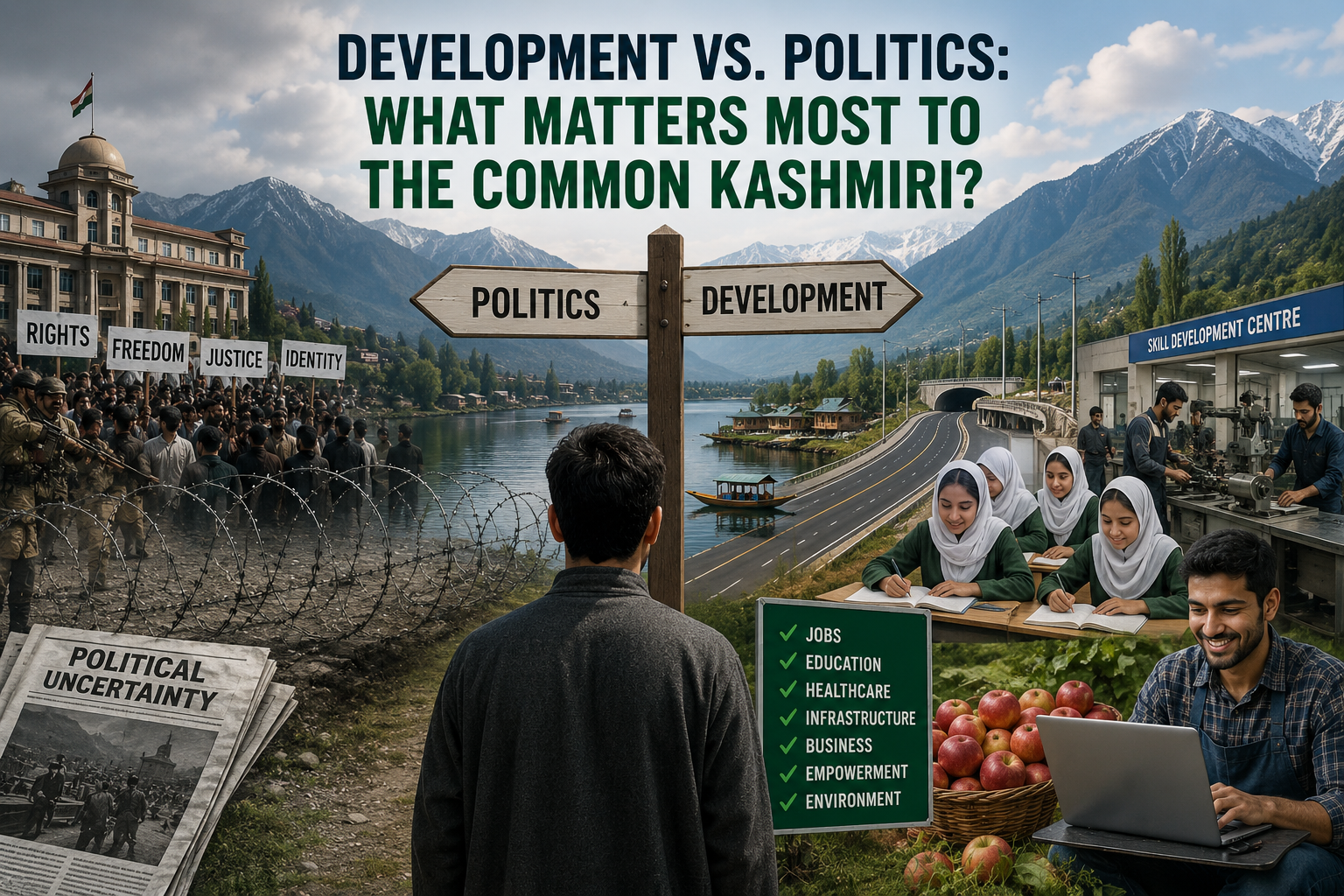
For decades, Kashmir has remained one of the most politically debated regions in the world. Governments have changed, political narratives have evolved, and countless promises have been made in the name of peace, democracy, and development. Yet, beyond television debates, social media campaigns, and political speeches lies the life of the ordinary Kashmiri—a fruit grower waiting for better market access, a student searching for quality education, a young graduate looking for employment, a woman striving for financial independence, and a labourer hoping for a secure livelihood.
This raises an important question: What truly matters most to the common Kashmiri—politics or development?
The answer is neither simple nor absolute. Politics undoubtedly shapes governance and public policy, but for the average citizen, everyday concerns often outweigh ideological debates. A family’s priorities are usually centred on earning a stable income, educating children, accessing healthcare, ensuring safety, and living with dignity. Development, therefore, becomes not merely an economic concept but a human aspiration.
The Everyday Reality
Imagine a small apple orchard owner in Shopian. Every year, he invests months of hard work cultivating his crop. His concerns are practical rather than political. He worries about irrigation, transportation, storage facilities, fair market prices, and unpredictable weather. If roads improve, cold storage becomes available, and better marketing channels emerge, his income rises. His quality of life improves irrespective of political slogans.
Similarly, a young engineering graduate in Srinagar dreams of finding employment close to home. Instead of migrating to another city, he hopes industries, IT companies, and startups will create opportunities within Kashmir. For him, development means jobs rather than endless political debates.
These examples represent thousands of ordinary Kashmiris whose aspirations revolve around economic stability and social progress.
The Cost of Political Uncertainty
No society can flourish amid prolonged uncertainty. Kashmir has witnessed decades of political instability, security challenges, shutdowns, disruptions, and periods of economic slowdown. While political issues have dominated public discourse, they have often come at a significant cost to ordinary citizens.
Tourism—a major source of livelihood—has frequently fluctuated because of uncertainty. Small businesses have struggled to survive. Daily wage labourers have often suffered the most, as every day without work directly affects their family’s income. Students have experienced interruptions in their education, creating learning gaps that affect their future competitiveness.
Political discussions may occupy newspaper headlines, but missed school days, cancelled business opportunities, and reduced incomes have tangible consequences for families.
Development requires continuity, investor confidence, policy stability, and long-term planning. Frequent disruptions discourage investment and delay infrastructure projects that benefit everyone.
Employment: The Greatest Priority
Perhaps no issue concerns the common Kashmiri more than unemployment.
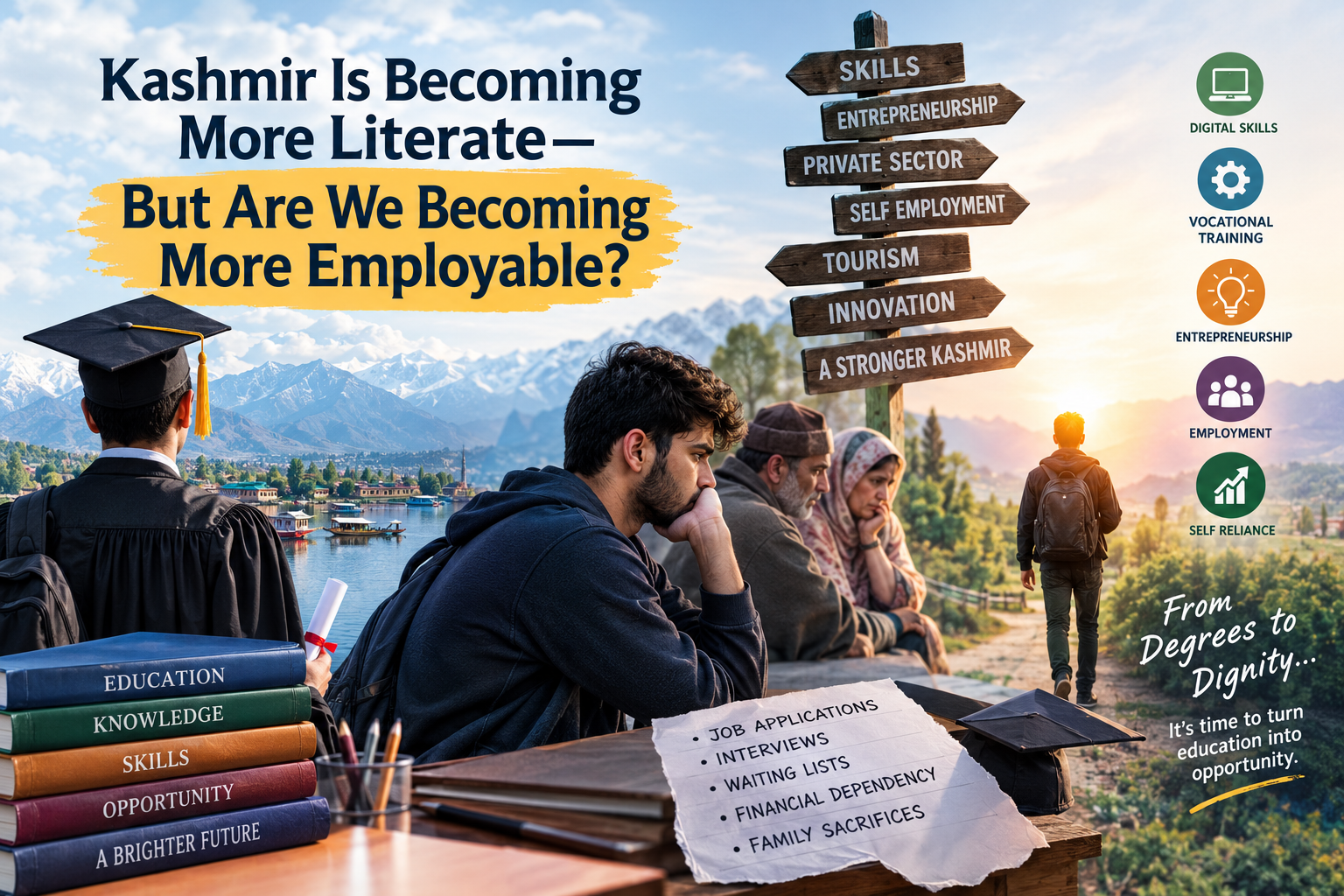
Kashmir has one of the youngest populations in India. Every year, thousands of educated youth complete degrees in engineering, medicine, management, arts, commerce, and technology. Unfortunately, employment opportunities have not kept pace with educational achievements.
Government jobs have traditionally been viewed as the safest career option. However, the number of applicants far exceeds available vacancies. This has created frustration among educated youth who spend years preparing for competitive examinations.
Development can change this equation.
Private investment, tourism expansion, handicraft exports, information technology, food processing industries, renewable energy projects, and entrepreneurship can generate diverse employment opportunities. Instead of depending solely on government recruitment, Kashmir can build an economy driven by innovation and enterprise.
Employment provides more than income—it restores confidence, reduces frustration, and strengthens social stability.
Tourism: Beyond Seasonal Income
Tourism has always been one of Kashmir’s greatest economic strengths. Blessed with breathtaking landscapes, snow-covered mountains, lakes, forests, gardens, and rich cultural traditions, Kashmir attracts millions of visitors.
However, sustainable tourism requires much more than natural beauty.
Improved roads, better sanitation, reliable electricity, skilled hospitality professionals, adventure tourism, heritage conservation, winter sports, and environmental protection all contribute to a successful tourism industry.
A thriving tourism sector creates employment not only for hotel owners but also for taxi drivers, pony handlers, artisans, photographers, restaurant workers, guides, transport operators, and local shopkeepers.
Development transforms tourism from a seasonal activity into a year-round economic engine.
Education: Building the Future
Every parent in Kashmir shares a common dream: providing quality education to their children.
Schools and colleges have expanded significantly over the years, but challenges remain. Digital infrastructure, teacher training, research opportunities, vocational education, and industry partnerships require greater attention.
Education must prepare students not merely to pass examinations but to compete in an increasingly global economy.
Technical institutes, skill development centres, coding academies, language training, entrepreneurship programmes, and innovation hubs can help transform Kashmir’s youth into job creators rather than job seekers.
True development begins in classrooms.
Healthcare Matters More Than Politics
For a family rushing a patient to hospital during an emergency, political debates become irrelevant. Their immediate concern is whether quality healthcare is available nearby.
Development in healthcare means well-equipped hospitals, specialist doctors, affordable medicines, emergency services, diagnostic centres, telemedicine, and accessible healthcare in remote villages.
The COVID-19 pandemic demonstrated the importance of strong healthcare systems worldwide. Kashmir is no exception.
Investing in healthcare directly improves human wellbeing and increases public trust in institutions.
Infrastructure Changes Lives
Roads rarely become political headlines, yet they influence daily life more than many political speeches.
Good roads reduce travel time, lower transportation costs, improve emergency response, boost tourism, facilitate trade, and connect remote communities.
Similarly, uninterrupted electricity supports industries, hospitals, schools, and digital businesses.
Reliable internet enables online education, freelancing, e-commerce, and remote employment.
Water supply, sanitation, drainage systems, public transportation, and urban planning collectively define the quality of life in any society.
Infrastructure development silently transforms economies.
Women as Drivers of Development
Women’s participation is essential for sustainable development.
Across Kashmir, women are increasingly excelling in education, healthcare, administration, entrepreneurship, handicrafts, journalism, and technology.
Self-help groups, financial inclusion programmes, skill development initiatives, and digital marketplaces have enabled many women to become financially independent.
When women earn, entire families benefit through improved nutrition, education, and healthcare.
Development that empowers women creates lasting social progress.
Agriculture and Horticulture
Agriculture remains the backbone of rural Kashmir.
Apple cultivation, saffron farming, walnut production, cherry orchards, vegetable farming, and floriculture contribute significantly to the region’s economy.
Yet farmers continue to face numerous challenges including climate change, post-harvest losses, transportation difficulties, fluctuating prices, and inadequate processing facilities.
Modern irrigation systems, scientific farming methods, cold storage infrastructure, food processing industries, and export promotion can substantially increase farmers’ incomes.
Development in agriculture means prosperity for rural households.
Entrepreneurship: A New Hope
A quiet transformation is taking place among Kashmir’s youth.
Many young entrepreneurs are launching cafés, travel companies, digital marketing firms, online businesses, handicraft brands, food startups, and technology ventures.
This entrepreneurial spirit deserves institutional support through easier access to finance, incubation centres, mentorship, simplified regulations, and digital infrastructure.
Every successful startup creates employment for several others.
Entrepreneurship reduces dependence on government employment while encouraging innovation and self-reliance.
Environmental Sustainability
Development cannot come at the cost of environmental destruction.
Kashmir’s forests, lakes, rivers, glaciers, wetlands, and mountains constitute not only natural heritage but also economic assets.
The health of Dal Lake, Wular Lake, Lidder River, and countless forests directly influences tourism, agriculture, and biodiversity.
Climate change has already begun affecting snowfall patterns, water availability, and agricultural productivity.
Sustainable development requires balancing infrastructure expansion with ecological conservation.
Protecting nature is itself an investment in Kashmir’s future.
Politics Still Matters
To argue that development alone matters would be incomplete.
Politics determines governance, legislation, resource allocation, public accountability, and institutional functioning. Effective political leadership creates the environment necessary for development.
However, politics becomes meaningful only when it improves people’s lives.
Citizens ultimately judge governments not only by speeches but by visible improvements in roads, schools, hospitals, employment, electricity, public services, and economic opportunities.
Development gives politics credibility.
The New Aspirations of Kashmiri Youth
Today’s young Kashmiri is connected to the world through smartphones, social media, and digital technology.
They compare opportunities not merely within Kashmir but with Delhi, Bengaluru, Dubai, London, and beyond.
Their aspirations include innovation, entrepreneurship, higher education, global careers, financial independence, and technological advancement.
They seek stability that allows them to build futures rather than merely survive the present.
This generation increasingly values practical opportunities alongside political awareness.
Finding the Balance
The debate should never be framed as choosing between politics and development.
Instead, Kashmir needs politics that facilitates development rather than obstructing it.
Healthy democratic discussions remain essential. Public participation, transparency, accountability, and responsive governance strengthen institutions.
At the same time, development should remain above partisan divisions.
Roads serve everyone.
Hospitals treat everyone.
Schools educate everyone.
Employment benefits everyone.
Environmental conservation protects everyone.
Development unites where politics often divides.
Conclusion
The common Kashmiri is neither indifferent to politics nor disconnected from larger constitutional and governance questions. Yet daily realities shape priorities in profound ways. A secure job, quality education, efficient healthcare, better infrastructure, thriving businesses, modern agriculture, clean surroundings, and opportunities for future generations often carry more immediate significance than political rhetoric.
History has shown that societies become stronger when political processes translate into tangible improvements in people’s lives. Development does not erase political differences, nor should it. Rather, it provides common ground where citizens of diverse opinions can work together for shared prosperity.
The true measure of progress in Kashmir will not lie solely in political milestones or electoral victories. It will be reflected in whether a graduate finds meaningful employment, whether a farmer earns a fair income, whether a child studies without interruption, whether tourists return with confidence, whether women have equal opportunities, and whether families can live with dignity, security, and hope.
For the ordinary Kashmiri, politics undoubtedly has its place. But when politics succeeds in delivering development, opportunity, and human wellbeing, it gains its greatest purpose. Ultimately, the strongest foundation for lasting peace and stability is not built only through political discourse, but through inclusive development that reaches every village, every family, and every young dreamer across the Valley.