Sheikh Sameer
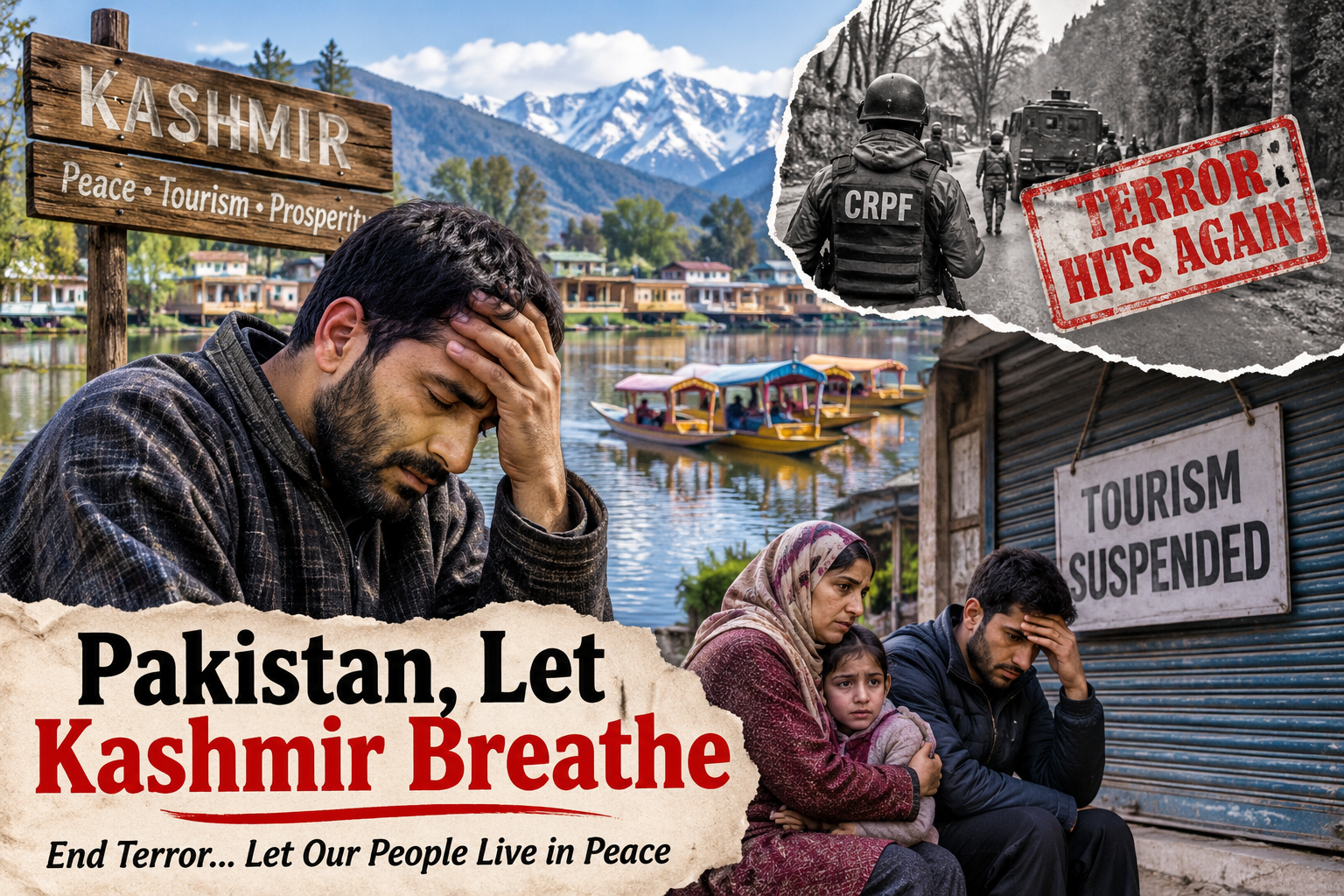
There is something deeply painful about living in a place where people are repeatedly forced to put their lives on hold because someone, somewhere, believes that violence is an acceptable way of pursuing a political objective. Every terrorist attack in Kashmir, whether small or large in scale, does much more than claim lives or challenge the security establishment. It pushes an ordinary Kashmiri back into uncertainty, fear and economic hardship. It takes people away from their workplaces, empties tourist destinations, disrupts businesses and forces families to reconsider whether they can afford another day of uncertainty.
The recent attack on CRPF personnel near Mir Bazar in Kulgam is another reminder that the threat of terrorism continues to haunt a region that desperately wants to move forward. While security agencies will investigate the attack and establish the identities and affiliations of those responsible, the larger question is what such violence actually achieves for the people of Kashmir. Does it bring development? Does it create employment? Does it improve the lives of ordinary families? Or does it simply push an already economically vulnerable population further towards uncertainty?
We remember the horrific Pahalgam terrorist attack, one of the most brutal and painful episodes in Kashmir’s recent history. Innocent tourists were killed, families were shattered and an entire region was left struggling to comprehend the cruelty of an attack directed against people who had come to experience the beauty and hospitality of Kashmir. The tragedy was not limited to the lives lost. Its consequences extended to thousands of families whose livelihoods depended on tourism.
Has Pakistan ever seriously considered the consequences of such attacks for ordinary Kashmiris? Has it ever thought about the taxi driver who spends months waiting for the tourist season, the hotelier who borrows money to prepare his property, the shikara owner who depends on visitors, or the small shopkeeper whose annual income is largely determined by a few months of tourist activity?
Perhaps those who plan and facilitate such violence never consider these human consequences. For them, an attack may be a tactical operation or an attempt to generate headlines. For an ordinary Kashmiri, however, its consequences can last for months.
Following the Pahalgam attack, an atmosphere of uncertainty and silence descended upon the Valley. Tourist movement suffered a severe setback, bookings were cancelled and businesses that had prepared for the season suddenly found themselves struggling to survive. The economic shock travelled from hotels and travel agencies to taxi operators, pony owners, guides, restaurant workers, handicraft sellers and countless small businesses.
I have personally witnessed taxi drivers breaking down under financial pressure because they could neither pay their vehicle instalments nor adequately provide for their families. These were not people involved in politics or international disputes. They were ordinary working Kashmiris trying to earn an honest livelihood. For many of them, a tourist season represents the difference between financial stability and another year of accumulated debt.
This is the reality Pakistan must understand.
Kashmir does not possess a diversified economic structure comparable to many other regions of the country. We do not have a substantial industrial base, large manufacturing clusters, extensive corporate employment opportunities or a widespread presence of multinational companies that can absorb thousands of unemployed people. While agriculture, horticulture, handicrafts, government employment and other sectors contribute to the economy, tourism remains one of the most important sources of livelihood, particularly in the services sector.
Our economy is therefore particularly vulnerable to disruptions in tourist confidence.
Unlike major metropolitan destinations, Kashmir does not experience an uninterrupted tourist boom throughout the year. Tourism is seasonal, with particular dependence on the early summer months and other favourable travel periods. Businesses make investments, arrange vehicles, employ workers and prepare accommodation in anticipation of these limited windows of economic activity.
And this is precisely what makes the timing of terrorist attacks so devastating.
When an attack occurs just as tourists begin returning, the damage extends far beyond the immediate incident. Travel advisories, cancellations, apprehensions and negative publicity can affect an entire season. The consequences are felt by people who have absolutely no connection with the violence.
Barely had the tourism sector begun recovering its confidence following the Pahalgam tragedy when another attack near Mir Bazar reminded people that the threat had not disappeared. For an ordinary Kashmiri, such incidents revive memories of economic losses and the fear that another season could be disrupted.
Pakistan must ask itself what it has actually achieved through this cycle of violence. Apart from the military consequences of Operation Sindoor, what has been the social and psychological impact of such actions on the people it repeatedly claims to represent? Has it ever considered the resentment and anger that terrorist violence generates among ordinary Kashmiris?
Pakistan has often described Kashmir as its jugular vein. But what kind of concern is demonstrated by policies and actions that repeatedly inflict suffering on the very people it claims to stand for? If Kashmiris are indeed so important to Pakistan’s political imagination, why should their economic survival, peace and aspirations become casualties of its strategic calculations?
The Pahalgam attack did not strengthen the prospects of peace or improve Pakistan’s standing among ordinary Kashmiris. Instead, it reinforced the rejection of violence among people who want their children to study, their businesses to prosper and their families to live without fear. Sympathy for Kashmiris cannot be manufactured through terrorism, nor can political claims be legitimised by targeting innocent people.
There is another dimension that deserves attention. Every terrorist attack creates an atmosphere in which ordinary residents are compelled to return indoors, businesses become cautious and public life loses its confidence. The economic impact is accompanied by psychological exhaustion. People who have spent years trying to move beyond conflict are once again reminded of their vulnerability.
The people of Kashmir have endured decades of violence, uncertainty and economic disruption. They understand the price of instability better than anyone sitting across the border. They have witnessed generations lose opportunities, businesses collapse and families struggle to rebuild their lives. What they seek today is neither another cycle of confrontation nor another political experiment conducted at the expense of their future. They want normalcy, employment, education, investment and the freedom to participate in the country’s economic growth.
The response to terrorism must therefore be firm, intelligent and sustained. Security agencies must dismantle terrorist networks and their support structures, while the administration must strengthen the economic resilience of vulnerable sectors. Tourism infrastructure, alternative employment opportunities, industrial investment and private-sector participation are essential if Kashmir is to reduce its dependence on a limited number of economic activities.
But above all, the ordinary Kashmiri must not be forgotten in the larger security discourse.
Pakistan, let Kashmir breathe. Let its taxi drivers earn their livelihoods, let its hoteliers welcome guests, let its young people pursue careers and let its families plan their futures without wondering whether another terrorist attack will destroy everything they have worked for.
Your every intervention through violence pushes ordinary Kashmiris backwards. Your actions do not create prosperity, strengthen public confidence or improve the prospects of the people you claim to represent. They only deepen economic distress and strengthen the desire among ordinary people to distance themselves from a politics built around violence.
Kashmir has already paid an enormous price for conflict. It deserves the opportunity to live, work, grow and prosper. We are much better without your intervention. We want peace, not patronage; opportunities, not propaganda; and a future defined by our aspirations, not by the calculations of those who continue to view violence as an instrument of policy.
Please let Kashmir survive economically. Please let its people breathe.