M S Nazki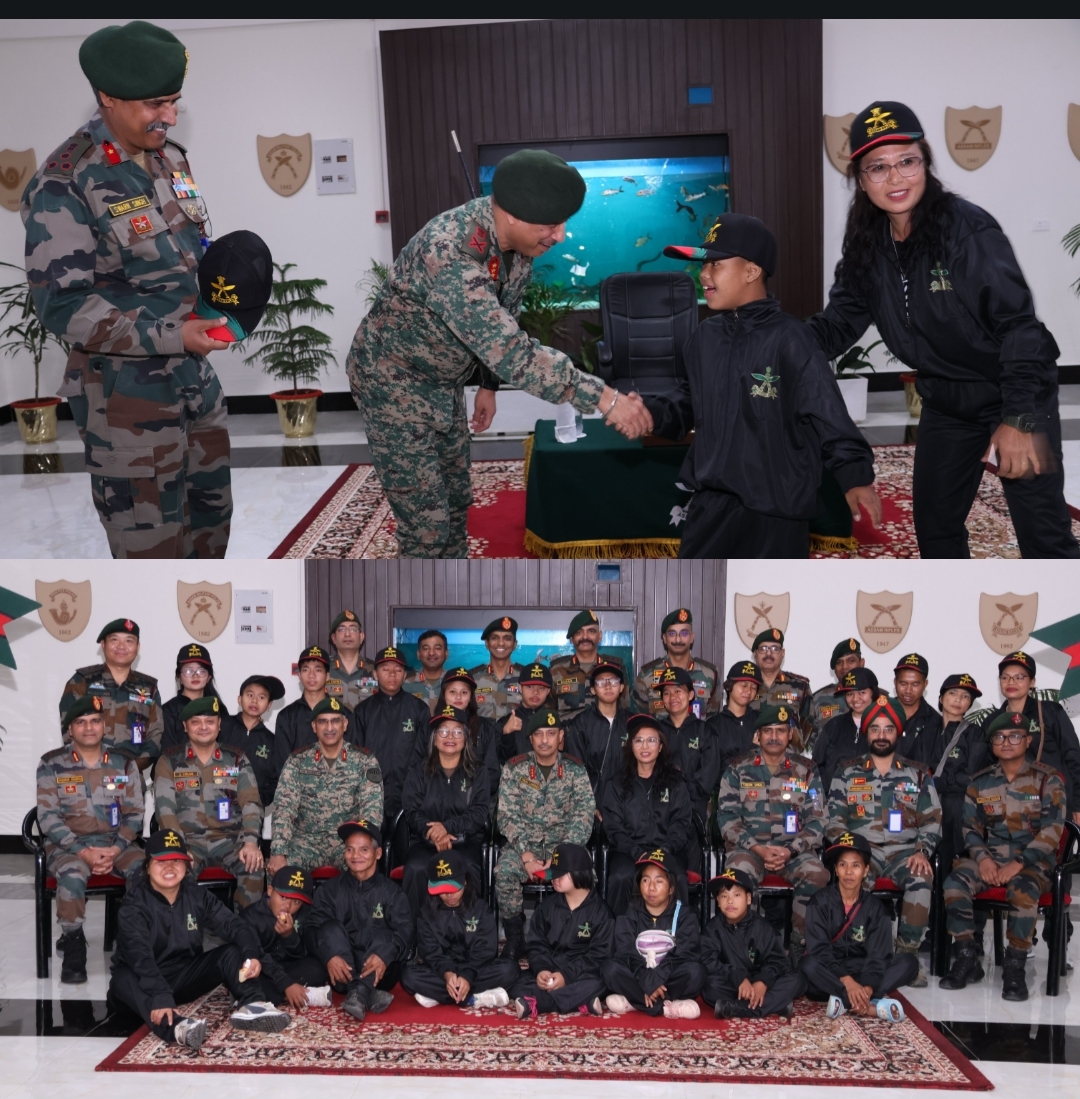
-The story which we got was, DG Assam Rifles inspires specially abled students during Interaction in Shillong!
By M S Nazki
-Assam Rifles facilitated a heartwarming interaction between specially-abled students of Shalom Special School, Serchhip and Lt Gen Vikas Lakhera, AVSM, SM, DG Assam Rifles at HQ DGAR, Shillong.
-During their educational tour, 18 students and 5 teachers had the opportunity to engage with the Director General, who encouraged them and applauded their resilience, enthusiasm and spirit.
-The interaction served as a powerful reminder of courage and determination, reflecting Assam Rifles continued commitment to fostering strong civil-military bonds and contributing to the well-being of communities in the region.
-Shillong, the “Scotland of the East”, was established by the British in 1864 as a civil station for the Khasi and Jaintia Hills, later serving as the capital of Assam province. It became the capital of Meghalaya upon its formation in 1972. Historically known as “Yeddo,” the town served as a crucial administrative and trade hub.
-British Influence: The area’s rolling hills reminded British officials of Scotland, leading to the nickname. The Shillong Club was established in 1878 to cater to colonial officials.
-Administrative Shift: From 1874 until 1972, Shillong served as the capital of Assam.
-Formation of Meghalaya: When Assam was reorganized, Shillong became the capital of the new state of Meghalaya in 1972.
-Colonial Infrastructure: Key landmarks such as the Lady Hydari Park were developed during this period.
-Shillong has since grown from a small village into a bustling city, balancing its colonial legacy with its identity as a hub for cultural and tourism activities in Northeast India.
-To start with I have a deep knowledge of Sillong since I have studied there! And Assemese was one language I never knew though it was necessary as a third language! I was in class eight and she Bharti was in class seven, Loreto convent! I had seen her walking on two legs but that Wednesday I saw her on a wheelchair! ‘Can’t you walk?’Why are you on a wheelchair cart’! I cannot walk because my legs are out of the mark. She screamed back! It was Wednesday evening when we were watching an English movie, ‘The Legend’! Story dates back to 1972 when we had defeated Pakistan in 1971! Then I spoke about him to my father who was a Commanding officer in one of Gurkha Battalions (I do not want to take the name because I too was commissioned into the same unit but some seniors let me down)! My father immediately got her admitted to the Army hospital! She was back on her legs! But we had to part!………She did come to see me off at Guwahati Railway Station and kissed my forehead! The short little love affair had to ens……….That was the last time we met!…….!
- Resilience, enthusiasm, and spirit, what is it?
-Resilience, enthusiasm, and spirit combined represent the indomitable human drive to thrive, commonly referred to as the “resilient spirit”. It is the capacity to not just survive adversity, but to bounce back with energy, positivity, and a commitment to growing stronger through challenges.
-Here is a breakdown of these interconnected qualities:
-Resilience (The Ability to Bounce Back): This is the psychological and emotional strength to adapt to change, manage stress, and recover from failures or setbacks. It involves viewing obstacles as opportunities for growth rather than insurmountable dead ends.
-Enthusiasm (The Energy to Keep Going): This is the passion, optimism, and “long-life battery” that keeps spirits high during difficult times. It drives individuals to continue pursuing their goals with joy, despite setbacks.
-Spirit (The Core Inner Strength): This is the intangible, inner force or “will to fight” that refuses to succumb to despair. It often includes a sense of purpose, faith, or connection to a higher meaning.
-Key Characteristics of This Combination:
-Adaptability: The ability to bend without breaking and change course when necessary.
-Unwavering Optimism: Resilient people are often “incorrigibly optimistic,” viewing challenges as temporary and solvable.
-Proactive Problem-Solving: Instead of passive waiting, it involves taking action to address issues.
-Growth Mindset: The belief that abilities can be developed, allowing individuals to learn from mistakes.
-“Success is stumbling from failure to failure with no loss of enthusiasm.” — Often attributed to Winston Churchill, this quote perfectly captures the intersection of resilience (stumbling from failure) and enthusiasm (no loss of spirit).
-Cultivating this “Resilient Spirit” can be done by building strong relationships, setting realistic goals, maintaining perspective, and taking care of one’s physical and mental health.
-Specially-abled students are individuals with physical, cognitive, sensory, or developmental differences—such as autism, cerebral palsy, visual impairment, or dyslexia—requiring specialized educational approaches.
-These students, sometimes referred to as having special needs or being differently-abled, need tailored teaching methods, assistive technology, and adapted environments to learn and reach their full potential.
-Key Aspects of Specially-Abled Students:
-Categories of Needs:
=Physical: Conditions affecting mobility or motor skills, such as muscular dystrophy or limb differences.
-Sensory: Impairments involving sight (blindness/low vision) or hearing (deaf/hard of hearing).
-Cognitive/Developmental: Learning disabilities (e.g., dyslexia), Autism Spectrum Disorder, or Down syndrome.
-Behavioral/Emotional: Conditions such as ADHD or anxiety disorders.
-Educational Support: These students often benefit from Individualized Education Programs (IEPs), specialized instruction, and inclusive settings that address specific learning disabilities, communication disorders, or intellectual challenges.
-Diverse Abilities: The term emphasizes that while these students may learn differently or have limitations, they possess unique capabilities and can lead active, productive lives with proper support.
-Environmental Adjustments: Schools often need to provide accessible infrastructure (ramps, braille), special tools, or sensory-friendly environments.
-Understanding that disability is a form of diversity helps create an inclusive environment where these students can thrive.
Specially-abled students and individuals worldwide demonstrate extraordinary resilience, overcoming severe physical and intellectual limitations to achieve remarkable success in sports, academics, and entrepreneurship. Stories include Jiya Rai, an autistic girl who set a world swimming record, and Kartiki Sawhney, a visually impaired student who became a Stanford University scholar.
-Inspiring Stories of Success and Resilience:
-Jiya Rai (Autism): An 11-year-old from Mumbai, she became the youngest and first special-needs girl to swim 14 kilometers, crossing from Elephanta Island to Gateway of India.
-Kartik Sawhney (Visual Impairment): Despite being denied entry to the IIT entrance exam for three years, this blind student earned a full scholarship to Stanford University, proving his capabilities in computer science.
-Rahelu (Physical Disability): After becoming paralyzed at eight months old, he overcame mobility challenges to win a silver medal in powerlifting at the 2014 Commonwealth Games.
-Charu (Intellectual & Physical Impairment): Overcame depression and limited mobility, finding her strength in sports at DISHA, a resource center.
-Amit (Intellectual Disability): Through specialized therapy, he developed the ability to communicate, eat independently, and participate in sports at Khushboo Welfare Society.
-Kajal & Ravi (Club Foot/Physical Disability): Through free surgeries from Narayan Seva Sansthan, they overcame severe mobility issues to run and play.
-Viha (Blindness/Multiple Disabilities): Overcame school rejection to excel at the Mariposa Foundation, which provides tailored support for children with disabilities.
-Abdul Rahim & Haroon Ejaz (Special Needs): Former students who overcame disabilities to win Gold Medals in badminton and table tennis, respectively, at the National Special Olympics.
-Advocacy and Education:
Mariposa Foundation (India): Founded by a mother (Sejal) to educate children with disabilities after mainstream schools rejected her visually impaired daughter, now supporting 40+ children.
-These stories emphasize that with appropriate support, perseverance, and opportunities, specially-abled students can break societal barriers and excel in any field.
-Several specially-abled students and individuals from North East India have achieved significant success, overcoming severe physical challenges through sheer determination. Key examples include para-cyclist Rakesh Banik (7,000-km journey), para-athlete Ababil Ali (World Para Athletics Grand Prix), and academic achievers like Nasrin Ahmed. These individuals demonstrate remarkable resilience in sports, arts, and education.
-Key Inspiring Individuals from North East India:
-Ababil Ali (Assam): Made history as the first para-athlete from Assam to represent India at the World Para Athletics Grand Prix 2025 in New Delhi.
-Rakesh Banik (Assam): A para-cyclist from Nagaon who completed a 7,000-km “Volga to Brahmaputra Cycle Expedition” from Moscow to Guwahati, traversing multiple countries.
-Nasrin Ahmed (Assam): A specially-abled student from Bongaigaon who passed the HSLC examination with distinction (62%).
-Piteshwar Rabha (Assam): A craftsman from Tezpur who creates art using only one hand.
-Shishu Sarothi Students (Assam): Fifteen students with cerebral palsy and other disabilities performed at the National School of Drama in New Delhi.
-Tuhin Dey: Though often listed nationally, this student learned to write with his mouth, scoring 88% in his class 10 boards, inspiring many with his determination.
These achievers represent the incredible talent and indomitable spirit present within the specially-abled community of the North East.
-Shalom Special School
Shalom Special School in New Serchhip, Mizoram, is a dedicated educational institution for children with special needs, supporting around 55 students. Supported by local government, community members, and the Assam Rifles, the school focuses on education, vocational skills, and providing a supportive environment for specially-abled children in North East India.
-Key Details About Shalom Special School:
-Location: New Serchhip, Mizoram, North East India.
-Support & Beneficiaries: The school provides education to 55 children with special needs.
-Community Support: The school receives assistance from the Assam Rifles, who have held health camps and awareness programs there.
=Key Initiatives: It has been visited by dignitaries including the Mizoram Governor and Chief Minister, with the latter providing a 21-seater minibus for the students.
-Highlights: Students of this school have participated in talent-focused activities and educational tours, including engagements with the Director General of Assam Rifles.
-Function: It is run by the Spastic Society of Mizoram, which runs similar initiatives, as noted in reports about their special educational, vocational, and recreational initiatives.
-Recent Developments (2025-2026):
-August 2025: The Mizoram Governor visited the school, interacted with staff, and provided edibles for the children.
-April 2026: The Assam Rifles organized a World Autism Day Awareness Programme and medical camp for the students.
-April 2026: Students and teachers from the school took an educational tour to interact with the DG Assam Rifles in Shillong.
-This school acts as a crucial support center in the region, focusing on empowering special children through tailored education and community involvement.
So we come to the final lines: A mind caught in tradition cannot perceive what is true. If the mind is tethered to belief or knowledge, it ceases to follow the swift movement of ‘what is’. As long as the brain is conditioned, it cannot understand the immensity of the nature of the mind. The purpose of education is to create a new mind, which is explosive and does not conform to a pattern set by society. A mind is healthy, clear and sane when it has no conflict whatsoever, so that it functions without any friction. Only when the mind is quiet can you observe, for then the mind is sensitive to extraordinary beauty; and perhaps here is a clue to the problem of freedom…………..!
Author



 Sheikh Sameer

 The Kashmir Dialogues