Sheikh Sameer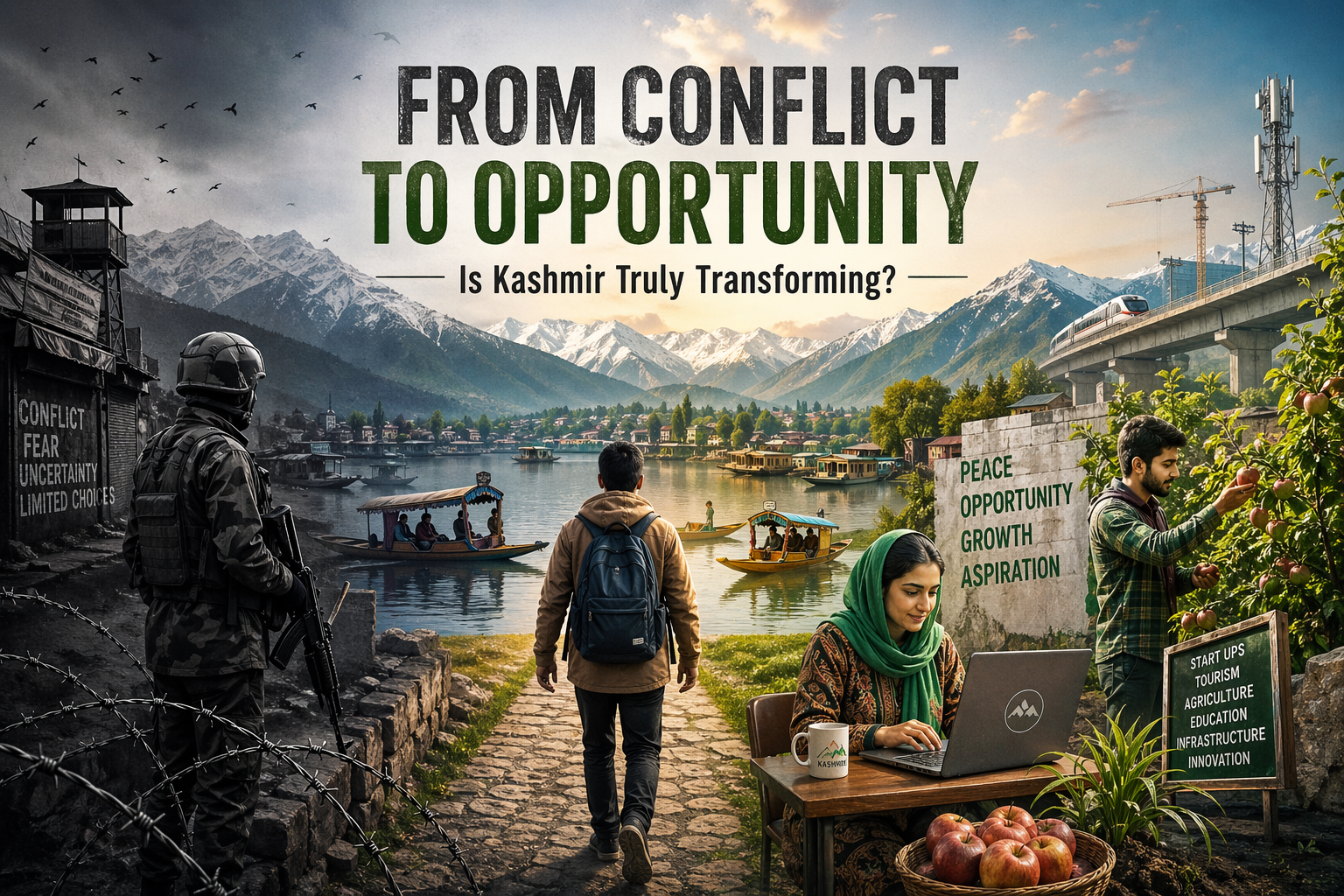
Beyond the Headlines
There was a time when Kashmir made headlines only for the wrong reasons—curfews, crackdowns, and conflict defined its global image. Today, the headlines are beginning to change. Words like startup, tourism boom, infrastructure push, and youth empowerment are slowly replacing the vocabulary of violence. But beneath this shift in narrative lies a deeper, more critical question:
Is Kashmir truly transforming, or are we witnessing a carefully constructed illusion of progress?
The answer is not as straightforward as it may seem. Kashmir today stands at a delicate crossroads—caught between the weight of its past and the promise of its future. What is unfolding is neither a complete success story nor a failed transition, but a complex, evolving reality that demands closer scrutiny.
Economic Awakening and the Rise of New Aspirations
Perhaps the most striking sign of change in Kashmir is not found in policy documents or official claims, but in the mindset of its people—particularly its youth. For decades, the aspiration of a secure government job dominated the career imagination of young Kashmiris. Stability was prized over risk, and survival often took precedence over ambition.
That mindset is slowly, but undeniably, changing.
Across the Valley, young entrepreneurs are stepping into spaces once considered uncertain or inaccessible. Small startups are emerging in sectors such as technology, e-commerce, mobility, and food processing. From eco-friendly transport initiatives in Srinagar to online platforms selling Kashmiri handicrafts worldwide, a new economic culture is taking shape—one that values innovation over dependence.
Even in rural areas, farmers are beginning to break away from traditional supply chains, exploring direct-to-market models and digital platforms. This shift represents more than economic activity; it signals a psychological transformation—from a conflict-conditioned society to an opportunity-seeking one.
Yet, this awakening is not without its limitations. Access to funding remains restricted, mentorship ecosystems are underdeveloped, and many promising ideas fail to scale due to structural bottlenecks. The entrepreneurial energy exists, but the ecosystem required to sustain it is still catching up.
Tourism Revival: Between Opportunity and Uncertainty
Tourism has always been Kashmir’s economic lifeline, and its recent revival is often presented as proof of normalcy returning to the region. Hotels are bustling, houseboats are occupied, and markets are alive with activity. Destinations like Gulmarg and Pahalgam have once again become symbols of Kashmir’s enduring appeal.
For thousands of families dependent on tourism, this resurgence has brought relief and renewed hope. Employment opportunities have increased, local businesses have flourished, and the region’s image has seen a positive shift.
However, this revival comes with an uncomfortable truth—it is fragile.
Kashmir’s tourism industry remains highly sensitive to security developments. A single untoward incident can trigger cancellations, disrupt livelihoods, and reverse months of economic progress. This volatility raises a critical concern: can an economy truly transform if its primary driver remains so vulnerable?
Tourism, while essential, cannot be the sole pillar of Kashmir’s economic future. Without diversification and long-term stability, its promise will remain uncertain.
Infrastructure and Connectivity
Transformation is often most visible in what can be seen—roads, buildings, and public spaces. In Kashmir, infrastructure development is gradually reshaping both the physical and economic landscape. Improved road networks, tunnel projects, and urban renewal initiatives are enhancing connectivity and reducing the region’s long-standing sense of isolation.
Equally transformative is the rise in digital connectivity. Internet access, once inconsistent, is now enabling new forms of engagement. Students are accessing global education platforms, artisans are reaching international markets, and young professionals are exploring remote work opportunities.
This integration into the digital and physical networks of the wider world is crucial. It not only expands economic possibilities but also reshapes aspirations. However, the benefits remain uneven. While urban centers like Srinagar are witnessing rapid progress, many rural areas continue to lag behind, highlighting the need for more balanced development.
Growth Without Absorption
Despite visible progress, one challenge continues to cast a long shadow over Kashmir’s transformation—unemployment. A large segment of educated youth remains without meaningful employment, caught in a cycle of aspiration and frustration.
This presents a paradox that cannot be ignored: economic activity is increasing, but job creation is not keeping pace.
Degrees in engineering, management, and other professional fields often fail to translate into employment opportunities within the region. As a result, many young people either migrate in search of work or remain dependent on the limited prospects available locally.
The deeper issue lies in the disconnect between education and industry needs. Skill development initiatives exist, but their scale and effectiveness are insufficient to address the magnitude of the problem. Until this gap is bridged, the promise of transformation will remain incomplete.
Reinventing the Local Economy
Amid the rise of new industries, Kashmir’s traditional sectors are also undergoing a quiet transformation. Handicrafts, horticulture, and agriculture—long the backbone of the region’s economy—are being reimagined for a modern market.
Kashmiri artisans are increasingly using digital platforms to showcase their work, reaching customers far beyond local markets. The apple industry, a critical economic pillar, is adopting better storage, packaging, and marketing practices to enhance profitability.
This blending of tradition and innovation is one of the most promising aspects of Kashmir’s transformation. It ensures that development is rooted in local identity while adapting to global opportunities. However, challenges such as inconsistent market access, lack of branding, and vulnerability to external shocks continue to limit growth.
The Question of Inclusivity
No transformation can be considered complete unless it is inclusive. In Kashmir, the benefits of development are not evenly distributed. Urban areas are advancing more rapidly, while rural regions often struggle with limited infrastructure and opportunities.
Similarly, economic gains tend to be concentrated among certain segments of society, leaving others on the margins. For many, the narrative of transformation remains distant—something seen on screens rather than experienced in daily life.
True progress requires that opportunity reaches every corner of the region, empowering not just the privileged, but also the overlooked and underserved.
Perception vs Reality: Two Kashmirs
Kashmir today exists in two parallel realities.
One is the Kashmir of rising tourist numbers, growing startups, and improved infrastructure—a story of progress and potential. The other is a Kashmir where unemployment persists, economic vulnerabilities remain, and development feels uneven.
Both realities are true.
The challenge lies not in choosing one over the other, but in understanding how they intersect. Progress must be acknowledged, but not exaggerated. Challenges must be addressed, but not used to dismiss genuine achievements.
A Future Still in the Making
Kashmir’s journey from conflict to opportunity is not a finished story—it is an unfolding process. The region has undoubtedly moved forward. There is greater economic activity, improved connectivity, and a visible shift in public mindset. But the transformation is still fragile, still uneven, and still incomplete.
The real test lies ahead.
Will Kashmir be able to create sustainable employment for its youth?
Will development reach its rural heartlands?
Will economic growth become resilient to external shocks?
These are the questions that will determine whether the current trajectory leads to lasting change or remains a momentary phase.
Final Reflection
In Kashmir, transformation is no longer a distant dream—it is a visible possibility. But possibility alone does not change realities.
The true measure of change will not be in statistics or headlines, but in the quiet dignity of everyday life—when a young Kashmiri no longer has to choose between hope and home.



 Rameez Makdoomi
 The Kashmir Dialogues