Sheikh Sameer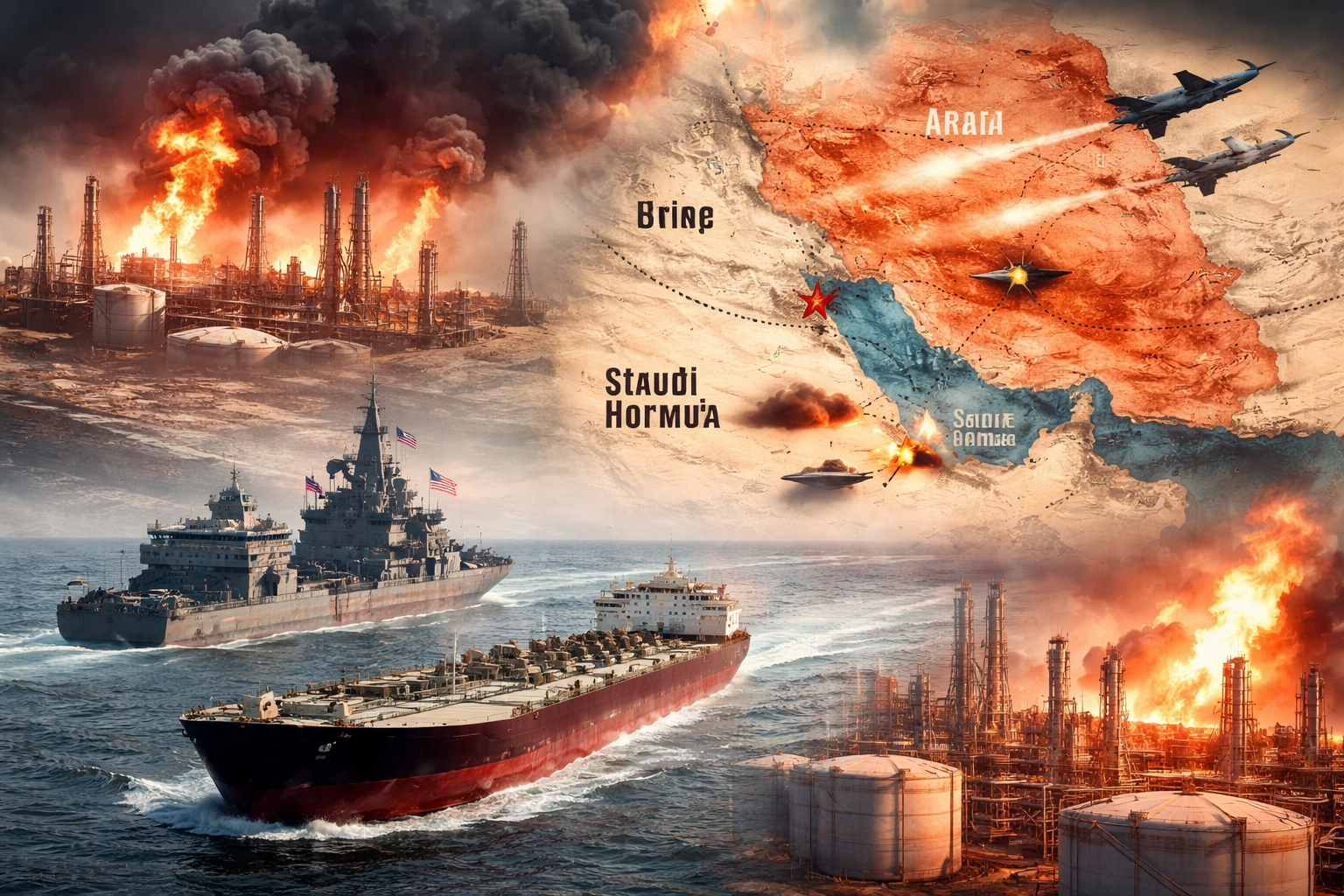
The Middle East has always been a geopolitical tinderbox, but the ongoing 2026 Iran war has pushed the region—and the global economy—into one of its most precarious phases in decades. What was once a simmering rivalry has now escalated into direct confrontation involving major military powers, threatening not only regional stability but also the lifelines of global energy supply.
From disrupted oil exports to naval blockades and threats to critical chokepoints, the consequences of this conflict are already reverberating across global energy markets. The world today is witnessing a stark reality: instability in the Middle East is no longer a regional issue—it is a global economic shockwave in motion.
War in the Energy Heartland
The Middle East holds nearly half of the world’s proven oil reserves, making it indispensable to global energy security. However, the current conflict has turned this energy hub into a battlefield.
The war began with coordinated airstrikes by the United States and Israel on Iran in February 2026, targeting strategic military and nuclear sites. Iran responded with missile and drone attacks across the region, including strikes on U.S. bases and Israeli territory.
What makes this conflict particularly dangerous is its geographical spread. Unlike previous wars, this confrontation has spilled into multiple countries, including Iraq, Syria, and Gulf states, creating a multi-front crisis that directly intersects with global energy infrastructure.
Strait of Hormuz: The World’s Energy Artery Under Threat
At the center of this crisis lies one of the most critical chokepoints in the world:
the Strait of Hormuz.
Nearly one-fifth of the world’s oil supply passes through this narrow waterway. Any disruption here is not just a regional concern—it is a global emergency.
In recent weeks, the conflict has brought this artery dangerously close to collapse:
Iran has threatened to block or disrupt shipping routes
The U.S. has expanded naval blockades targeting Iranian vessels
Maritime tensions have intensified with warnings of attacks on ships
The situation has already caused shipping delays and increased insurance costs for oil tankers. Even without a full closure, the mere threat is enough to send global oil prices soaring.
Energy Supply Shock: A Crisis in Motion
One of the most immediate consequences of the war has been a disruption in energy supply.
Iran, a major energy producer, has already taken drastic measures:
It has halted petrochemical exports following Israeli strikes on key facilities
Production infrastructure has been damaged
Domestic prioritization has reduced global supply availability
At the same time:
U.S. naval blockades are restricting Iranian oil exports
Regional instability is affecting production in neighboring countries
These developments are creating a classic supply shock—reduced availability of energy in global markets—leading to rising prices and heightened uncertainty.
Oil Prices: Driven by Fear as Much as Reality
Energy markets are highly sensitive to geopolitical risk, and the current conflict has amplified this sensitivity.
Prices are being influenced not only by actual supply disruptions but also by:
Fear of escalation
Speculation in financial markets
Uncertainty about future supply
As the war intensifies, oil markets are entering a phase of “risk premium pricing”—where prices rise in anticipation of potential disruptions rather than actual shortages.
This volatility creates ripple effects across the global economy:
Higher transportation costs
Increased inflation
Pressure on industrial production
Global Economic Fallout
The impact of Middle East instability is not confined to energy markets—it extends to the broader global economy.
Rising oil prices are historically linked with:
Slower economic growth
Increased inflation
Higher cost of living
The current conflict is already pushing the world closer to these outcomes.
For developing economies, the situation is particularly severe. Countries dependent on energy imports are facing:
Rising import bills
Currency depreciation
Fiscal pressure
For advanced economies, the challenge lies in balancing inflation control with economic growth—especially in an already fragile post-pandemic recovery phase.
India and South Asia: Feeling the Heat
For countries like India, the impact of the conflict is immediate and tangible.
India imports a significant portion of its oil from the Middle East. As prices rise:
Fuel costs increase domestically
Inflationary pressures intensify
Trade deficits widen
Additionally, any disruption in Gulf economies—where millions of Indians work—can affect remittances, adding another layer of economic vulnerability.
For regions like Kashmir, where economic opportunities are already limited, such global shocks can further strain livelihoods, especially in sectors like transport, tourism, and small businesses.
Militarization of Energy Routes
What sets the current crisis apart is the militarization of energy supply chains.
The U.S. has expanded its naval presence and blockade operations, targeting Iranian shipping networks globally. �
Iran, in response, has issued warnings of retaliatory actions, including threats to sink ships.
This creates a dangerous scenario:
Commercial shipping becomes a potential target
Insurance costs skyrocket
Trade routes become unpredictable
Energy is no longer just an economic commodity—it has become a strategic weapon in this conflict.
Regional Spillover: A Wider Energy Crisis Looming
The war is no longer confined to Iran, Israel, and the U.S. It has triggered a wider regional escalation:
Iran-backed militias are targeting U.S. interests in Iraq and Syria
Hezbollah has escalated tensions with Israel
Gulf states are on high alert
This regionalization of the conflict increases the risk of:
Attacks on oil facilities in Saudi Arabia or UAE
Disruption of LNG exports from Qatar
Broader instability across energy-producing regions
Such a scenario could trigger a full-scale global energy crisis, comparable to or even worse than past oil shocks.
Energy Markets and Speculation: The Invisible Hand
Financial markets are amplifying the crisis.
Traders and hedge funds are reacting rapidly to every development:
Missile strikes
Diplomatic breakdowns
Naval movements
This speculative behavior increases price volatility, often beyond what supply-demand fundamentals would justify.
In essence, energy markets today are driven as much by perception and fear as by actual supply conditions.
Acceleration of Energy Transition
Ironically, the crisis may accelerate the global shift towards renewable energy.
Repeated shocks from Middle East instability are forcing countries to reconsider their energy dependence. As a result:
Investments in solar and wind energy are increasing
Countries are exploring alternative suppliers
Strategic reserves are being expanded
However, the transition is not immediate. Fossil fuels continue to dominate, and in the short term, the world remains deeply dependent on Middle Eastern energy.
Is This the Beginning of a Global Energy Crisis?
The current trajectory raises a critical question:
Are we witnessing the early stages of a global energy crisis?
The indicators are concerning:
Active military conflict in a key energy region
Disruption of supply chains
Rising oil prices
Threats to critical chokepoints
Unlike previous crises, this one is unfolding in a highly interconnected and fragile global economy already dealing with inflation and slowing growth.
The Way Forward: Navigating a Volatile Future
To mitigate the impact of this crisis, coordinated global action is essential.
1. Diplomatic De-escalation
A sustained ceasefire and diplomatic engagement are critical to stabilizing the region.
2. Energy Diversification
Countries must reduce dependence on a single region for energy supply.
3. Strategic Reserves
Expanding and effectively using oil reserves can cushion short-term shocks.
4. Investment in Renewables
Long-term stability lies in transitioning to sustainable energy sources.
5. Global Cooperation
Unilateral actions can worsen crises; collective strategies are needed.
The ongoing Iran–US–Israel war has transformed Middle East instability into a global energy flashpoint. What was once a risk is now a reality, with tangible impacts on oil supply, prices, and economic stability.
The world stands at a critical juncture. The decisions made in the coming weeks and months will determine whether this crisis remains contained or escalates into a full-scale global economic disruption.
For nations like India—and regions like Kashmir—the stakes are particularly high. Energy is not just about fuel; it is about livelihoods, development, and stability.
In an era defined by uncertainty, one truth remains clear:
the fate of global energy markets is inseparable from the stability of the Middle East.



 The Kashmir Dialogues
 Rameez Makdoomi